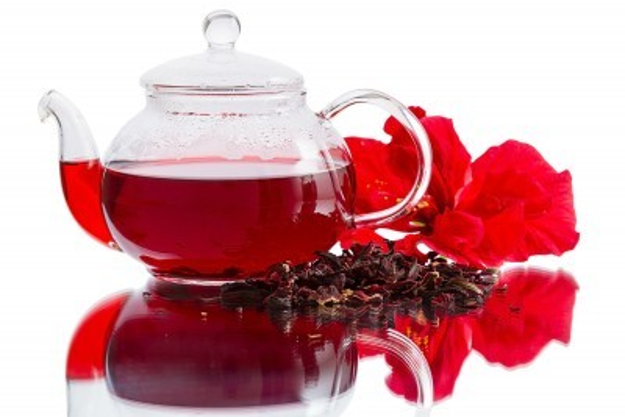
Hibiscus tea is made from the dried flowers of the hibiscus tree and is a popular drink in Egypt as well as in other countries. While you can drink hibiscus tea hot, my preference is for it to be chilled.
So if you have hibiscus tea bags, cut the tea bag and drop the leaves/powder into the water, add sugar and boil it. If you have very few tea bags add very little water – preferably only a little more than a teacup. The tea needs to be strong for the flavour to emerge.
Once it has boiled, put it aside to cool. After it reaches room temperature, transfer it into another vessel, post straining it. Then keep it in the refrigerator to chill. Once it has chilled sufficiently, pour it out into glasses and serve it.
Hibiscus tea looks like sherbet but has a very kokum-like flavour. And much like kokum juice, it is cooling and refreshing.
For those who feel tea is boring, hibiscus tea is the one to change your perception. It can pass of for a party drink instead of the usual carton juice. But, keep in mind you ask for it to be chilled because when hot the flavour is… diluted.
If you like your tea strong and have only tea bags at home, Never fear! Cut the tea bag and add the contents directly to the water and let it boil.
For one, you wouldn’t have to use too many tea bags for one mug of strong tea – keeping all those lovely tea bags for a rainy day when you require brown comfort.
Sip and settle back to relish your lovely mug of tea…
Oru sulaimanilum oru ithri mohabbat venam. Athu kudikumbol lokam ingane pathake vantha nikyanam – Kareem ikka
A little bit of love should be added to every sulaimani you serve. When one has that, the whole world should come to a standstill.
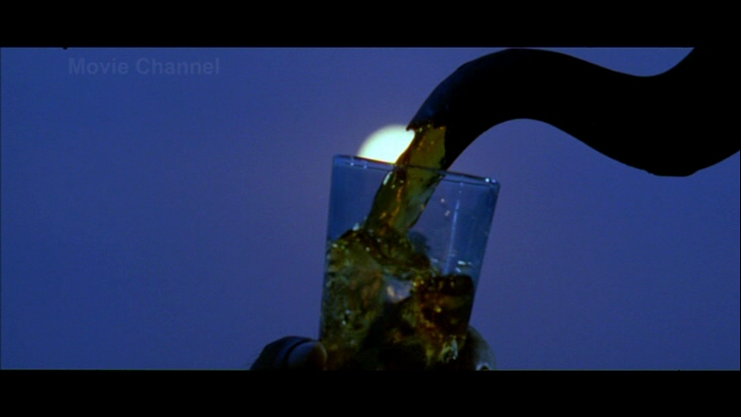
One of the most beautiful quotes in praise of sulaimani chai and it comes from one of my favourite films on food – Ustad Hotel. It is clear that the writer Anjali Menon and the director Anwar Rasheed love sulaimani chai because of the focus given to the experience; the frequent moments when Kareem ikka or Ustad is pouring out tea, is presented as special.
Sulaimani chai also known as Solomon’s tea is said to be invented by the wise King Solomon. Besides imparting wisdom, he was known for his fine knowledge in spices and his experimentation in the culinary arts. According to legend, he used these very arts to bed the Queen of Sheba.
So the story goes that from the moment he set his eyes on her he realised he wanted her. But while his lust overpowered him, she saw it only as an intellectual romance. He tried everything to seduce her but she remained steadfast.
The end of her visit was drawing near so he hit upon a desperate plan. He placed a condition on her that if she asked for anything, anything at all after the final meal she would have to sleep with him. She agreed; certain that there was nothing else she required. So Solomon made the meal very spicy and plied her with wines. But they did not assuage her thirst so she woke at night and asked for a drink of water…
Well, this could be just a legend but you never know, maybe if Solomon had brewed this special tea for her, maybe she wouldn’t have held out for so long.
There are many ways sulaimani chai can be made and enjoyed, but my favourite or the one that gives me the best results is something I first had at a local tea stall at Wayanad. I asked the lady for the recipe and so this is it –
Boil the tea leaves/powder with the sugar or jaggery (in case you prefer honey, add it just before drinking. When the tea is too hot, the flavour of the honey gets dulled). The amount of tea leaves added depends on how strong you like your tea. For me, when I make a mug of tea, I add one flat teaspoon and may sprinkle some more if I’m not satisfied. You have to gauge depending on the colour or your memory of the flavour. I usually make a pot, so it is roughly three teaspoons for me and I may adjust based on the look of it.
Use fully fermented tea leaves or black tea for this. Darjeeling tea is generally the most easily available.
After the tea has boiled and the leaves have slowly settled at the bottom of the vessel, filter it out. If you are using jaggery, this is a helpful step because it usually has some dirt or foreign particles that you can now filter out.
Now, and this is the step I emphasise, squeeze the lemon or lemons, (depending on how much you are making and how lemony you like it), into the tea and boil it. The boiling of the lemon helps remove the tart, raw lemon flavour and blends it in beautifully!
Of course, some people prefer to add the lemon while the water is almost done boiling or directly into their tea mug – that’s their preference.
You can drink the tea exactly like this or you can end by adding mint and basil leaves. They give a lovely flavour and are healthy besides. If you prefer a spicy undertone to your tea, you can boil cloves, cardamom or cinnamon with your tea leaves. I also, occasionally boil ginger with my tea. The ginger tastes almost candied at the end.
So enjoy this intoxicating concoction and let’s hope that your world stands still.
Tea is a love affair and for me it properly took off when I was fifteen. Prior to that, I used to be addicted to coffee but over the years my coffee consumption has become something of an annual engagement. Do not get me wrong, I don’t particularly dislike coffee but its hold on my heart has waned. So now for me drinking it is like a nostalgic exercise.
Tea on the other hand for me is almost a sacred experience and I prefer to share my tea-moment with someone who doesn’t cloud my ‘aura’ as probably Phoebe from FRIENDS would put it.
Tea is obviously not a new fascination. It revolutionised trade and became suddenly the past time that everyone in the west wanted to indulge in. It even gave competition to the coffee houses of England.
Each community and culture has its own way of approaching tea. Most have raised it to an art form and have stylised ways of appreciating it. For instance, in Japan, the ceremony for drinking tea is already known. The thing is, while it is stylised, it is also a humble and philosophical experience. The ceremony is called sadou – way of the tea. It implies that tea will bring you to a better understanding of self or maybe even a dismissal of self.
I believe every tea has a story and sometimes it is the story that comes up between the tea and the drinker of the tea. So I want to tell you stories about tea, its history, and my recipes of perfect brews. I also want to discover new teas and share them with you. I have my preference for non-milk tea but I’m going to explore even the so-called scorned territory of milk tea.
So let’s embark on this journey, for the love of tea.
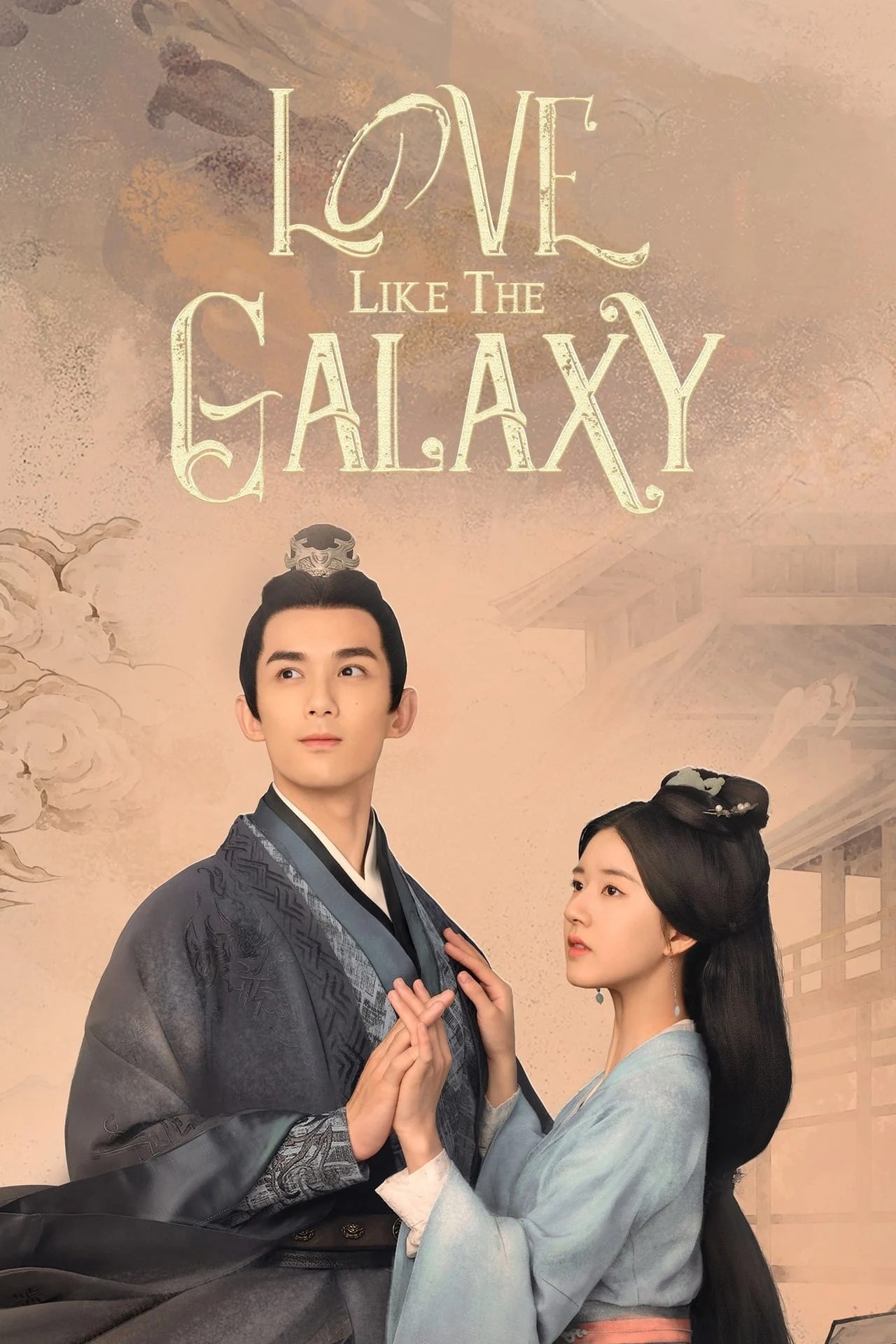
Written By: Zou Yue and An Yi Mo; Adapted from a novel by Guan Xin Ze Luan
Cast: Leo Wu; Zhao Lusi; Guo Tao; Zeng Li; Li Yun Rui; Yu Cheng En; Xu Jiao; Bao Jian Feng; Tong Lei; Cao Xi Wen; Gao He Yuan; Zhang Yue; Kira Shi; Sha Bao Liang; Zhao Zi Qi; Candy Zhang; Yu Xiao Guang; Xu Di; Chen Si Si; Wang Ya Jia; Sun Kai; Zhang Chen; Wang Zhuo Cheng
Language: Mandarin
Genre: Historical; romance; drama
Number of Episodes: 56
Run Time: 45 minutes each
Love Like The Galaxy is a Chinese historical romance drama that complexly weaves family dynamics, political intrigue, with inner-palace plotting to bring to life a society that is slowly settling into a peaceful era after decades of strife and upheaval.
More than 20 years before the story begins, the current Emperor Wen (Bao Jian Feng) resolved to overthrow the corrupt and violent Emperor Li whose reign had terrorised the people. Many like-minded individuals banded together to support him and he eventually ascended the throne. But the remnants of Emperor Li’s associates continued to plague the land resulting in uncertain lives, with border regions particularly affected. This meant that families were either separated or destroyed as a result of the wars.
One such family is that of our protagonist Cheng Shaoshang (Zhao Lusi) who was left behind by her parents who were military generals and raised away from her siblings for 15 years, in the company of her biased grandmother Old Madam Cheng (Xu Di) and scheming second aunt Madam Ge (Chen Si Si). Shaoshang’s brothers were with their parents at military camps and may have been raised with military discipline but still with the protection and presence of their parents. She, however, was neglected by her grandmother, who preferred sons and was abused her aunt, who hated her mother. Her aunt starved her on frequent occasions to ‘punish’ her for her faults and she was raised to be barely literate. We realise later, that Shaoshang’s frail health, referenced quite often in the early segments of the series has to do with the malnourishment she endured as a child.
Shaoshang is a plucky, resourceful and intelligent girl who realises very early on that she is the only one who can protect herself. So, while lacking in book knowledge but clearly possessing a strong interest in understanding and creating machinery or mechanical objects, she teaches herself about the things fascinated her. On a number of occasions, she uses her intelligence as a guard around her. The blatant lack of affection in her upbringing, poorly supplied by her maid and confidante, Lian Fang (Wang Ya Jia), has made her wary. Thus, in a society governed by Confucian principles, she is far too individualistic.
Her parents return at the beginning of the story, but Shaoshang’s joy at the reunion is short-lived because she never receives the affection she craved for, from her mother, Xiao Yuan Yi (Zeng Li). Her father, Cheng Shi (Guo Tao), thrilled to be reunited and not a little guilty at the long separation is widely indulgent of her behaviour and she basks in the happiness of it. Her mother however, not a little alarmed at how ill-brought up her daughter is, especially since she is considered of age in their society, aggressively attempts to supply the lack by a strict regimen of education and not infrequently belittling her, in comparison with her cousin Yang Yang (Xu Jiao), her second aunt’s daughter. The only saving grace is that the cousins are actually close, with Madame Ge often criticising her daughter for ruining her plans of ill-treating Shaoshang, by secretly feeding her when she would punish her by withholding her meals.
If we look at the mother objectively, she is not wrong in her fears. In conservative Chinese society, a woman who fails to adhere to etiquette after marriage could be given a bill of divorce and sent away from the family and have no way of challenging it. This bill could incidentally be given, not just by the husband, but even by the elders of the family. In fact, quite early in the series, we are shown this, where a woman, is sent away with a bill of divorce by the elders of the family, because she is accused of being wilful and lacking virtue– the very things Shaoshang is culpable of, because she truly lacks manners.
Neither can the parents keep the girl at home unmarried for too long because not only would they be criticised, but her prospects would reduce. Her mother then, very naturally, wants to teach her fast. However, to a child like Shaoshang, who has only received discipline and criticism, affection masked as criticism, does not help but wound. It adds to her already existing wounds of abandonment and bruised self-worth. Instead, she requires affection and firmness, also the occasional indulgent approval, to truly blossom – something she receives much later on from Empress Xuan Shen An (Tong Lei), when she begins to wait on her.
Our male protagonist, Ling Buyi (Leo Wu), also known by the courtesy name Zisheng, is a decorated general, who is popular in the capital for his brooding and stoic personality, greatly made appealing by his good looks. If Shaoshang is boldly expressive, he is the reverse image of her. They are both manipulative but their field of influence is different as is their approach. They both hold their cards close to them but her defensiveness in the early segments of the series make it more obvious, whereas his personality lets it slip under the radar.
The opening scene of the series introduces us to him and to his rather formidable status in the land. He is presented to us as someone who will do what is right even if it temporarily results in him bending the rules.
Much like Cheng Shaoshang, he carries within him the burdens of war. When he was six, 15 years ago, he and his mother Huo Junhua (Candy Zhang) were the only survivors of the Fall of Gu City which resulted in the massacre of his maternal family headed by his heroic uncle General Huo (Yu Xiao Guang), the sworn brother of the current Emperor.
Witnessing the massacre and the corpses of her siblings and other maternal relatives, broke Huo Junhua’s mind. Nevertheless, she and Zisheng managed to reach the capital, after nearly two years on the road. But Ling Yi (Sha Bao Liang) barely a year after the Fall of Gu City, married Chunyu Shi (Zhao Zi Qi. Huo Junhua, enraged at the betrayal, especially seeing him married to a woman who was her lady’s maid, suffered another episode, nearly cementing her illness. This and his parents’ divorce, resulted in Zisheng being adopted by the emperor and given the title Shiyilang, the Eleventh born of the royal household. This suited Zisheng because he had great respect for the Emperor and Empress, which was matched by deep-seated revulsion at his father’s callousness.
Shaoshang and Zisheng cross paths at the first episode itself. He arrives at the village she was been banished to as punishment, to track a criminal responsible for profiteering from military weapons. It seems to be a big underground racket of pocketing the money and releasing sub-standard weapons to the soldiers who then die because they are unable to defend themselves. We later learn that it is related to the Fall of Gu City, making this a murkier incident. Zisheng seems to be investigating the true culprits behind the massacre and it seems like it might be quite straightforward; except it is not. The plot is convoluted and much of it hides in darkness because there are number of different motivations, of varied and sometimes, unconnected groups of people, that derails the investigation, time to time.
What is truly fascinating, however, is that it is realistic in how it shows that the causes of an event can never be simplistic. Far too many people’s tiny choices lead to big fallouts. It then makes history complicated to unravel and not easy to fix. A good example, of a prescient individual trying to fix the future and failing tragically is the series, Moon Lovers: Scarlet Hearts Ryeo.
Love Like The Galaxy is essentially a bildungsroman – a story of growth, coming-of-age and more importantly, learning. Primarily for Shaoshang, but equally for Zisheng and in no small way, for her two other potential suitors, Luo Yao (Yu Cheng En) and Yuan Shen (Li Yun Rui). Unlike Shaoshang and Zisheng, their traumas emerge from class politics and the complicated dynamics of centuries-old noble houses but it nevertheless taints them.
One of the most important lessons in the series, which is reiterated is that there are at times things far bigger than personal desires and the latter must submit to it. Shaoshang learning it, is true to the genre of the bildungsroman, and it is rather fitting that it arrives at a poignant decision when she preambles the conversation with her mother with “loyalty and filial piety cannot co-exist”.
The lesson is not easy for Shaoshang because her past experiences have made her like a lone wolf that has been bruised so often that it snarls at real and imagined threats. But the thing with lone wolves is that they don’t survive long. They either die out or give into their despair and destroy themselves.
Interestingly, the story does an interesting pivot to show us who the real, dangerous lone wolf is and why having a pack can ultimately save your life.
The series, also, quietly cautions us against too much devotion and acquiescence. The emperor and his queens have a near-perfect relationship. There is no scheming or back-biting between the queens; there is true sisterly affection. But there are costs. When the emperor decided to step forward to take the throne, he needed the backing of the powerful Xuan clan, who in turn requested that he make Xuan Shen An, the empress. But Yue Heng (Cao Xi Wen) was already his wife and yet she had to tolerate the status of empress concubine because her affections paled in comparison to the nation’s needs. Emperess Xuan received a respectful, loving husband but his banter and warmth was for his childhood sweetheart and first wife. These experiences can cause wounds even in the most amenable heart.
Shaoshang’s greatest trial, in the story, is to find a balance between her individuality, that she asserts quite a bit in the beginning, and her need to blend in and endure certain greater decisions with equanimity. She frequently questions the need for filial piety without reciprocity in the relationship, a thought that is both shocking and refreshing to her hearers, and by the end of the series, she finds her own unique answer.
A bildungsroman’s main theme is education, so different people appear in a person’s life to help them learn certain qualities. In Love Like The Galaxy, the male suitors play that role for Shaoshang and she, in turn, does the same for them. Zisheng, for instance, helps Shaoshang break through her defences and guarded nature. He assists her in realising her great potential for love. Love is something she has intellectually known she deserves, and knows she has much to give, but in practise, she feels she does not deserve. Incidentally, this teacher learns the lesson rather late himself.
A personal grouse about the series is its lack of clarity regarding the timelines. Characters frequently mis-represent time and events which is rather confusing.
One of the beautiful things about the series is its characterisation. It is realistic. Childhood trauma is a predominant theme and characters are attempting to overcome it but setbacks push them back to an earlier stage of defensive behaviour.
So Shaoshang, who is usually impulsive, reaching to take revenge without thought, good sense and consideration to personal safety, learns to think before she leaps or begins to depend on others but when extremely agitated, regresses naturally. It would, after all, be very odd, if in the course of one year, a person made a permanent 180 in personality. Change is, more realistically, cyclical – with people changing, falling back, trying again and so on.
The characterisation is wonderfully deep, even for minor characters, giving them nuanced personalities. In fact, the characters begin by seeming stereotypical but reveal depths later. Also, none of that weird cliched close-up scheming facial expressions. Rather, the naturally reticent expressions one would wear in society, especially at a time when being prudent is essential for survival.
Distance as necessary for growth, is another theme of the series, playing on the idea that the right thing at the wrong time will still be wrong and one needs time to process and eventually accept the right thing.
Also, there is quite a bit of foreshadowing of a long-awaited event and it should, at least on hindsight, tell the viewer why the ending is as it is. Personally, it appealed because it tied with the characters and their growth arcs in the story.
If you enjoy slow-burn stories with romance going alongside family drama, political intrigue and explosive secrets – Love Like The Galaxy is for you.
But, if you prefer passionate romances or high-octane action, Love Like The Galaxy is will not be a great viewing choice.
The title, after all, refers to how everything has a place in the galaxy with nothing superior or inferior, and how this is the true basis of a healthy society and a healthy couple.
Sandeep Reddy Vanga’s Animal promises to be a violent, sexist blood fest but is actually a family drama centred around miscommunication.
Rannvijay (Ranbir Kapoor) aches for his father Balbir (Anil Kapoor)’s approval to a point where he leaves good sense and family etiquette behind, acting on impulse rather than logic. This, time and again, puts him at variance with his father. Rannvijay, however, views himself as the protector of the family and if anything, his purpose revolves around validation.
He marries Gitanjali (Rashmika Mandanna), a young woman from a middle-class Telugu family. He then cuts ties with his family till he hears that his father was a victim of a failed assassination. This is when we see his transformation into his alpha male fantasy. He uses his intelligence and cunning to smoke out the culprits and the whole thing leads to an extraordinary blood pumping showdown which wraps up the first act.
When the second act opens, we are told that there are greater things afoot and that he must continue with his special brand of revenge. The story one-dimensionally borrows from TheMahabharata to pad up the plot, while simultaneously slowing down the pace and revealing the gaps.
Ranbir Kapoor stands out, as he does in every role he chooses to essay. If anything, it is his energy and verve that helps you gloss over the wafer-thin plot. If the film intended to prove that Balbir was an over-demanding father who pushes his son to unseemly heights or maybe descents, for his approval – then they should have drawn from Devdas. Devdas underscores the trauma by the father in very few sequences and gives us the reason for Devdas’ indecisiveness. Or, if the plan was to show that Rannvijay is delusional and unhinged, the plot could have veered closer to Vaastav. But if the end result was to show the utter pointlessness of each decision, then a dark comedy would have at least made sense.
Nevertheless, some of the controversies surrounding the film should be addressed. It has been called horribly sexist. But is it? It is the garden variety sexism – ‘you need to listen to me because I am a man’ but not necessarily violent. It is dismissive of the woman’s choice but they speak up, often and loudly. Of course, this comparison is based on Vanga’s previous outings – Arjun Reddy and Kabir Singh.
While Arjun Reddy is the poster child for a bad male role model because of his over-emotional and unhinged behaviour. Rannvijay, however, when not acting on his delusional impulses or getting angry with people when they poke holes in his paranoid reality, is actually nice. It is in fact through Rashmika’s portrayal of Gitanjali that Rannvijay is actually redeemed, since she holds her own as an actor and a character within the narrative.
Much of the other ‘sexist’ conversations feel like you walked into a boy’s locker room and heard them discussing underwear, penis sizes, how often you do it or how a man must look commanding to keep his woman under control. They weren’t infuriating but actually tedious. They weren’t meant as asides that built on the realism of the narrative, the kind that you find in a Scorsese film. But rather one realises that these pointless conversations were being used as fillers to plug the holes in an otherwise weak plot.
Similarly, the grand entries and exits of the other actors such as Bobby Deol were used to puff up the plot. All the other actors were really good too in their two-bit roles if a little wasted as they were reduced to satellites orbiting Rannvijay.
The film’s BGM is gold. The songs too pack an emotional punch. The direction and editing are equally good even though it falters in the second half becoming tediously long.
Animal is to have a sequel, Animal Park which currently seems to pay homage to John Woo’s Face/Off and hopefully his brand of ‘gun-ballet’. That film eventually became cult so maybe fingers can be crossed. But to be very honest, Animal’s trailer (which is brilliantly made) gives it more complexity than it possesses.
Cast: Leonardo DiCaprio; Robert De Niro; Lily Gladstone; Jesse Plemons; Tantoo Cardinal; Cara Jade Myers; JaNae Collins; Jillian Dion; Jason Isbell; William Belleau; John Lithgow; Brendan Fraser
Language: English; Osage
Genre: Crime; Drama; Western
Run Time: 3 hours 26 minutes
Martin Scorsese’s Killers of the Flower Moon delves into the infamous history of the Osage Murders known as the Reign of Terror. However, unlike the eponymous book which is a non-fictional investigative text on the Bureau of Investigation’s efforts (later FBI) at uncovering the murders and cover-ups in Oklahoma, the film’s focal point is through the marriage of Molly Kyle (Lily Gladstone) and Ernest Burkhart (Leonardo DiCaprio).
We are told that the Osage Nation were forced to move to Oklahoma, an arid patch of land, giving up their ancestral spaces. They found oil in these lands making them overnight one of the richest communities in the US. The oil brought unbelievable wealth but it also brought white profiteers who believed that they had to ‘rescue’ the land and its wealth from the ‘incompetent people’ who own it. The Osage, according to US law, were declared ‘incompetent’ by the government and were given white benefactors/overseers who managed their property and gave them an allowance.
Into such a background, we have the entry of Ernest Burkhart. Discharged from service during the WWI, he comes to live with his uncle William Hale (Robert De Niro) or King Hale as he was known. Ernest, we are told, was a cook in the army. He was discharged because his injury would not permit him to do hard labour. We realise also that he is dim-witted. He is thus presented right from the beginning as a harmless man who cannot be a threat. And yet, a perfect pawn.
We see that Molly and Ernest are happily married; he is a devoted father and husband. But King Hale continues to be a spectre looming over not just Molly’s family but the entire community since he has ingratiated himself to the Osage Nation by learning the language, the customs and seemingly respecting it.
We are shown frequent, brutal deaths with obvious perpetrators and yet the fact that no one questions it means that they are performed with the tacit approval of the local law enforcement agency. There is a sham of a medical service – ‘treatment’ for the Osage illnesses as well as coroners who are hiding the cause of death rather than revealing it. Even the illnesses plaguing the Osage such as diabetes are not discussed in detail, but in passing referenced as a result of the consumption of a white diet unsuitable to the Osage. These conversations seemingly bemoaning the poor health practises is matched by high sugar dishes being served constantly.
Much more deep-seated is a racial framework that believes that the Osage, like other Native American tribespeople, do not deserve autonomy. They are not even seen as people. One of the most chilling dialogues is, when there is a discussion planning out the murder of Molly’s sister Reta (JaNae Collins) and her white husband (Jason Isbell). They are referenced as “a man and his blanket” – she is reduced to the traditional wearing blanket that Osage women wore and maybe the fact that she is but just his financial safety net. Marriage to white men, gave the Osage women seeming control over their property but in reality, the white overseer was now not court-appointed but the husband.
Even the fact that the Osage Nation needed to pay the FBI to conduct an investigation points out at the flawed state of affairs. One of the scenes that is increasingly repeated to a disturbing effect, is Molly looking at an intimate family gathering and finding it slowly filling up with unfamiliar people – they are white, ‘family’, smiling and yet dangerous. Even the scenes of the house’s interior, starkly changes from when she first invites Ernest over for dinner to when it is teeming with white people. The whole thing works like a metaphor for the settler colony that America is.
Much of the criticism levelled against the film has been about how it is more about white people and not the Osage expressing themselves in primary positions. However, when the point is to poke holes in racial privilege, it needs to come from a space where it becomes harder and harder to justify. Other peoples’ emotions can be discounted – ‘oh they feel too much’ – but buffoonery? Harder to explain.
The players engaging in it may be entirely oblivious of the flaws of their argument because to begin with, racism is one of those systems founded not on logic, because reason cannot be the bedrock of prejudice, but a blind cult-like belief. And nothing is more blinding than greed. We see that reflected when Ernest, in a scene similar to Molly’s disquiet at the unfamiliarity of her intimate family gathering, walks into the Hale house and is faced by grim-faced white people who look strangely alike and frightening. And much like a cult, they brainwash Ernest to parrot their ideas.
Personally, the film played out like a black comedy crime thriller because the conclusion seemed obvious. Even if you wanted to wish it away, it was like a foregone calamity – a complete train wreck. There is romance in Killers of the Flower Moon but it is not a romance. It is the antithesis. It is a betrayal.
Featured: Leena Kejriwal; Hasina Kharbhih; Samina; Ella; Zinna Ali Laskar; Shakti; Krishna; Shampa; Seema Saha
Language: English; Hindi; Bengali
Genre: Documentary
Run Time: 75 minutes
From the Shadows is a documentary film that explores the heavy and pertinent issue of trafficking in India. The narrative follows two different women in their journey to bring the women, girls, children —justice. What truly brings out the grit in this fight is the active involvement of the girls who have been impacted by trafficking and are choosing to speak out.
We follow Leena Kejriwal through the streets of Kolkata where she uses different stencils of a girl’s silhouette to create the shadow of a girl with – #missingirls on the walls. The thing to note about sex trafficking is that unless you have been personally impacted by it, it is easy to pretend that it is not happening around you. The shadows, the hashtags are there then to force a conversation that needs to happen for change to actually occur. Leena’s work can be found in different cities.
Through Leena, we are introduced to Samina (name changed to protect her identity) who is fighting to get her case into the courts of law so that the people who were responsible for having her sold might be punished for their crime. The worst of it is that they live in her neighbourhood, unaffected. She has a desire for closure which is thwarted because of the roadblocks in her access for legal justice. Leena works with her to support her case because convictions in trafficking cases are notoriously hard.
Hasina Kharbhih’s work brings us to the greater possibilities of legal redressal and the dangers in its pursuit. Her legal struggle to get Ella, a young woman who escaped and sought justice, was dangerous because of the threats made to their lives. Largely since there is big money involved and many hands get greased to smoothen such operations built on the bodies of young children.
Nevertheless, Ella’s story is a story of victory in that she is able to get her conviction. Hasina’s work explores the larger political frameworks that needs to be sensitized to reduce trafficking. Which is why her work is aimed at engaging with border forces of India, Bangladesh, Nepal so that these women can be found before they are spirited further away.
We are given insight into what motivates these women who are seemingly outside of the struggle in comparison to Samina and Ella, to fight, to invest their time and energy into a battle that is both exhausting as well as disheartening – both in terms of the little returns as well as the exposure to the heartbreaking stories of violence and betrayal that is inevitable in these cases.
One of the most inspiring incidents that the film covers, is that of Seema Saha, a school student who successfully stops the child marriage of a classmate. She also works with other teens in creating a map of safe spaces in their locality that could be circulated for the people to be made aware of. The authorities do not take their concerns seriously – a behaviour pattern that reflects the assumptions made about children as well as the general apathy that people feel when such concerns are voiced.
What is fascinating about From the Shadows is not the theme or the fact that it acknowledges that the fight against crimes of this nature is an arduous struggle but that it equally focuses on the positives. There is an actual possibility to get justice; it is not easy nor will it be soon and maybe not for everyone but it is possible.
From the Shadows uses shadow art, street art, and other forms that imply temporality, fragility and yet it underscores the idea that art can be political; that it can be used to make a statement. That street art can begin an important conversation that needs to happen incessantly. In fact, Miriam Chandy Menacherry herself dove into this story, the struggle, because of art. We are then reminded that art can power social critique. Trafficking may be an ongoing problem but it is one that needs to be made visible.
Doukyusei is based on the eponymous BL (Boys Love) manga by Asumiko Nakamura. Set in an all-boys school, it follows the romance between Hikaru Kusakabe and Rihito Sajou who are doukyusei or classmates.
The school is hosting a choir festival and each class is to put up a performance. During rehearsal with Hara sensei (Hideo Ishikawa), Kusakabe (Hiroshi Kamiya) happens to notice that Sajou (Kenji Nojima), the class top student, doesn’t sing along with the rest of the class. Kusakabe immediately assumes that Sajou must see himself as too good for these events. That is until, he accidentally catches him rehearsing quietly by himself, in the empty classroom.
Unsure of what prompts him, he decides to help Sajou practise for the choir festival and they begin spending time together. Complete opposites in personalities and interests – Kusakabe is outgoing and interested in making music; Sajou is quiet, introverted and devoted to academia. They nevertheless find their own private niche. Sajou makes time to attend Kusakabe’s late night band performance after his prep school, while Kusakabe walks with him till his prep school nearly every day.
The beauty of Doukyusei lies in the fact that it uses the most cliched BL setting ever – the high school, as well as the opposites attract trope. But it uses it to create a very heartwarming, realistic story about the absurdities and comedies of daily life.
In its portrayal of the anxiety of identifying as queer in a same-sex high school where frequently classmates couple out of proximity, lack of other options or plain curiosity, is realistic. The debilitating fear then of falling in love in such circumstances is beautifully brought through, after all, there is no guarantee that your emotions are going to be acknowledged by your partner after you graduate. It also then comments on the common trope that some people just ‘seem’ that way.
The film uses a lovely watercolour animation aesthetic and tells the story in an episodic style divided into seasons that explore the passage of time and growth. Especially since, people who spend time often, will eventually influence each other’s personalities or behaviour patterns.
The ordinariness, the overwhelming awareness of desire for your partner, the random tiffs, the equally random conversations that add to the comic and endearing element of the story is what makes it truly slice of life. “I’ll be waiting for you, darling” will forever be for me, one of the most adorkable moments of the film.
Written By: Based on Let’s Try The World by Qing Lengyue
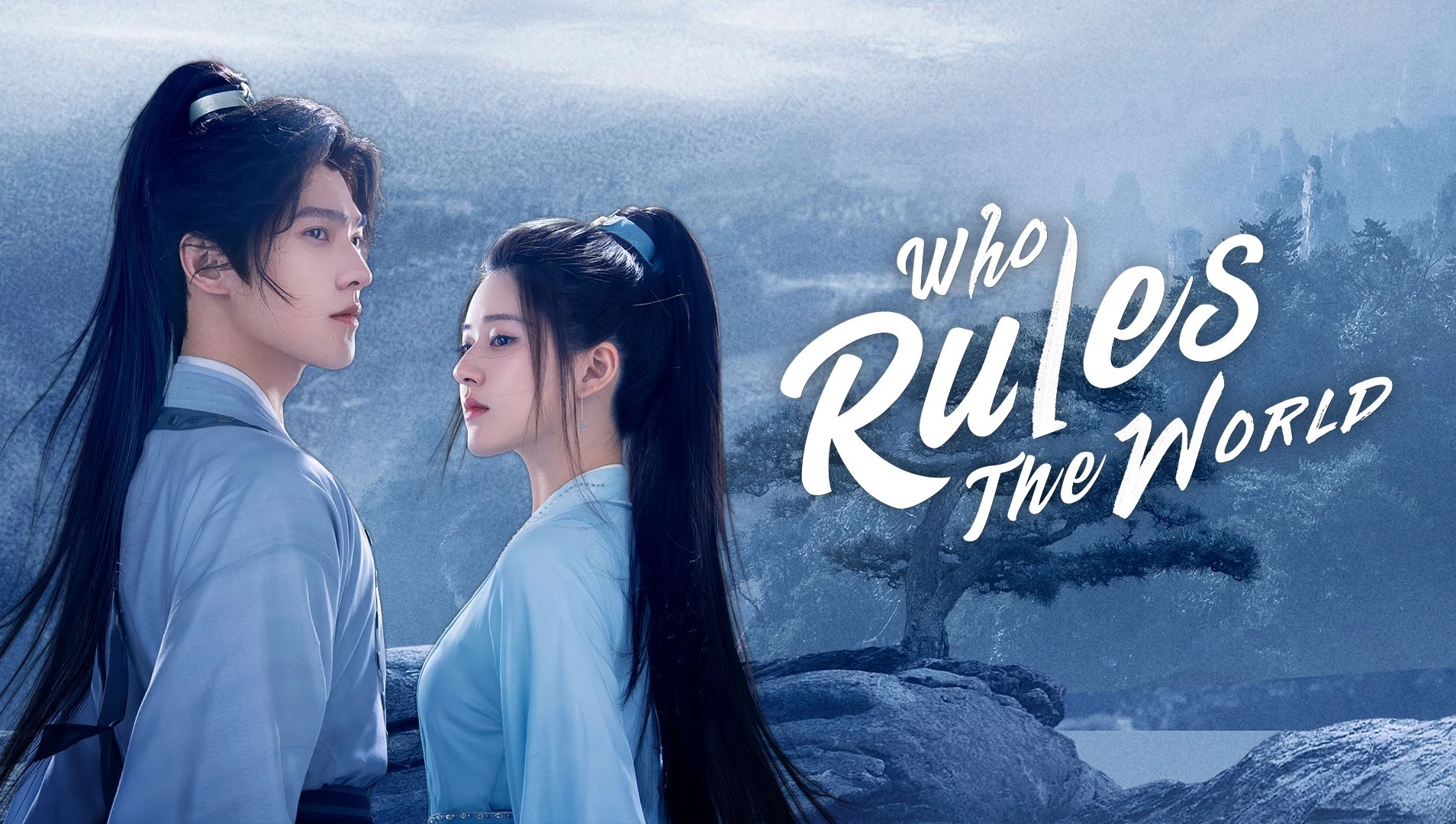
Cast: Yang Yang; Zhao Lusi; Leon Lai Yi; Zhang Haowei; Liu Ruilin; Huang Yi; Xuan Lu;Zhang Fengyi; Carman Lee; Jiang Kai; Zhang Tianyang; Wang Xuan; Zhao Zhuoting; Jiang Feng; Ai Mi; An Yuexi; Wang Gang; Du Zhiguo; Li Jiulin; Ma Yue; Fu Bo Han
Language: Mandarin
Genre: Wuxia; Fantasy; Romance
Number of Episodes: 40
Run Time: 45 minutes each
A Chinese wuxia fantasy drama with an engrossing world-building, Who Rules The World follows two renowned members of the martial arts world Hei Fengxi (Yang Yang) and Bai Fengxi (Zhao Lusi) as they use their powers for justice. They each follow the code of honour in the martial arts world but differently – Hei Fengxi is elegant, restrained and calculating. Bai Fengxi is majestic, unbridled and altruistic. They have clashed on number of occasions but are, despite the sarcastic repartees, respectful of each other’s abilities. Since this is wuxia and they are martial artists, they have god-like abilities. They also understand each other intimately; a meeting of minds that comes from duelling and so are much like soulmates.
However, just as much as the series emphasises the connection or the red thread of fate that ties the two together, it equally depicts the unrest that is fermenting in the world.
The Dadong Empire holds the Empyrean Token which gives it the right to rule the world. The other six states – Yongzhou, Jizhou, Qingzhou, Youzhou, Shangzhou and Beizhou, function autonomously but must respond to the call of the emperor (Du Zhiguo). This system has worked well for decades. But when the story begins, we see that each of the states are vying for power and waiting for a crack in the force of the empire that they can exploit. So, when the Empyrean Token is stolen, it sets the wheels in motion for the fight for the title of ruler of the world or emperor.
But nothing is as it seems. For when Bai Fengxi ends up entrusted with the Token, by a dying commander of Jizhou, who requests her to hand it over to the crown prince Huang Chao (Leon Lai Yi), Hei Fengxi who examines it, reveals that it is a fake. The idea that a fake token could be circulating means that there is more to this than meets the eye and that there might be deeper plots underfoot. This incidentally is the central theme of the series because none of the characters are necessarily who they seem. Nearly all of them are hiding another identity.
Hei Fengxi and Bai Fengxi themselves seem to have a greater stake in this fight. They are not nearly as disinterested as they should be as members of the martial arts world. It is implied that they have close connections to one of the six states – Yongzhou for Hei Fengxi and Qingzhou for Bai Fengxi.
The series goes into the inner workings of each of the states and the internal politics aimed at fulfilling personal greed. We see battles for succession within the states and how it spills over into world politics. Equally how external forces try to interfere in these battles so that it works to their advantage – to annex a state embroiled in civil conflict. Especially in the case of Yongzhou, through the figure of the third prince Feng Ju (Liu Ruilin), we see how self-destructive it becomes, through his fascinating portrayal of jealousy and cynicism.
The series explores ambition and the compromises one makes to fulfil it. On the other, it also shows what might happen when you discover something more important than the desire for power.
Who Rules The World continually surprises the viewers in the turns it takes. The pace is measured in the beginning so that the viewers can follow the world-building but the deeper it goes into the political machinations in the narrative, it starts to hurtle ahead, with each subplot taking the action further. The chemistry of the lead actors brings out the sense of timelessness to the romance as well the maturity of people who have grown together. It finally is about what do you truly fight for and what makes you a ruler of the world.