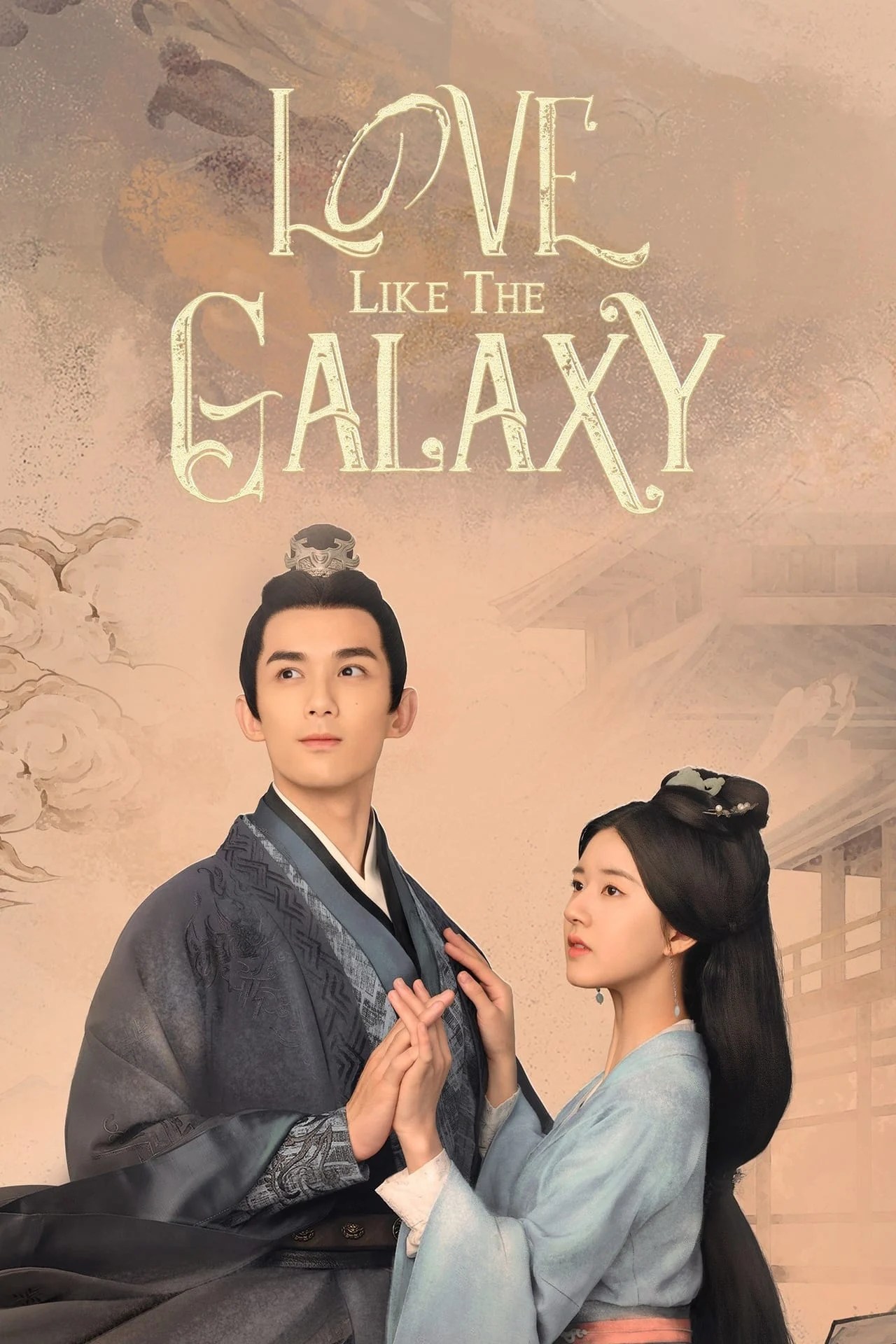
Directed By: Fei Zhen Xiang
Written By: Zou Yue and An Yi Mo; Adapted from a novel by Guan Xin Ze Luan
Cast: Leo Wu; Zhao Lusi; Guo Tao; Zeng Li; Li Yun Rui; Yu Cheng En; Xu Jiao; Bao Jian Feng; Tong Lei; Cao Xi Wen; Gao He Yuan; Zhang Yue; Kira Shi; Sha Bao Liang; Zhao Zi Qi; Candy Zhang; Yu Xiao Guang; Xu Di; Chen Si Si; Wang Ya Jia; Sun Kai; Zhang Chen; Wang Zhuo Cheng
Language: Mandarin
Genre: Historical; romance; drama
Number of Episodes: 56
Run Time: 45 minutes each
Love Like The Galaxy is a Chinese historical romance drama that complexly weaves family dynamics, political intrigue, with inner-palace plotting to bring to life a society that is slowly settling into a peaceful era after decades of strife and upheaval.
More than 20 years before the story begins, the current Emperor Wen (Bao Jian Feng) resolved to overthrow the corrupt and violent Emperor Li whose reign had terrorised the people. Many like-minded individuals banded together to support him and he eventually ascended the throne. But the remnants of Emperor Li’s associates continued to plague the land resulting in uncertain lives, with border regions particularly affected. This meant that families were either separated or destroyed as a result of the wars.
One such family is that of our protagonist Cheng Shaoshang (Zhao Lusi) who was left behind by her parents who were military generals and raised away from her siblings for 15 years, in the company of her biased grandmother Old Madam Cheng (Xu Di) and scheming second aunt Madam Ge (Chen Si Si). Shaoshang’s brothers were with their parents at military camps and may have been raised with military discipline but still with the protection and presence of their parents. She, however, was neglected by her grandmother, who preferred sons and was abused her aunt, who hated her mother. Her aunt starved her on frequent occasions to ‘punish’ her for her faults and she was raised to be barely literate. We realise later, that Shaoshang’s frail health, referenced quite often in the early segments of the series has to do with the malnourishment she endured as a child.
Shaoshang is a plucky, resourceful and intelligent girl who realises very early on that she is the only one who can protect herself. So, while lacking in book knowledge but clearly possessing a strong interest in understanding and creating machinery or mechanical objects, she teaches herself about the things fascinated her. On a number of occasions, she uses her intelligence as a guard around her. The blatant lack of affection in her upbringing, poorly supplied by her maid and confidante, Lian Fang (Wang Ya Jia), has made her wary. Thus, in a society governed by Confucian principles, she is far too individualistic.
Her parents return at the beginning of the story, but Shaoshang’s joy at the reunion is short-lived because she never receives the affection she craved for, from her mother, Xiao Yuan Yi (Zeng Li). Her father, Cheng Shi (Guo Tao), thrilled to be reunited and not a little guilty at the long separation is widely indulgent of her behaviour and she basks in the happiness of it. Her mother however, not a little alarmed at how ill-brought up her daughter is, especially since she is considered of age in their society, aggressively attempts to supply the lack by a strict regimen of education and not infrequently belittling her, in comparison with her cousin Yang Yang (Xu Jiao), her second aunt’s daughter. The only saving grace is that the cousins are actually close, with Madame Ge often criticising her daughter for ruining her plans of ill-treating Shaoshang, by secretly feeding her when she would punish her by withholding her meals.
If we look at the mother objectively, she is not wrong in her fears. In conservative Chinese society, a woman who fails to adhere to etiquette after marriage could be given a bill of divorce and sent away from the family and have no way of challenging it. This bill could incidentally be given, not just by the husband, but even by the elders of the family. In fact, quite early in the series, we are shown this, where a woman, is sent away with a bill of divorce by the elders of the family, because she is accused of being wilful and lacking virtue– the very things Shaoshang is culpable of, because she truly lacks manners.
Neither can the parents keep the girl at home unmarried for too long because not only would they be criticised, but her prospects would reduce. Her mother then, very naturally, wants to teach her fast. However, to a child like Shaoshang, who has only received discipline and criticism, affection masked as criticism, does not help but wound. It adds to her already existing wounds of abandonment and bruised self-worth. Instead, she requires affection and firmness, also the occasional indulgent approval, to truly blossom – something she receives much later on from Empress Xuan Shen An (Tong Lei), when she begins to wait on her.
Our male protagonist, Ling Buyi (Leo Wu), also known by the courtesy name Zisheng, is a decorated general, who is popular in the capital for his brooding and stoic personality, greatly made appealing by his good looks. If Shaoshang is boldly expressive, he is the reverse image of her. They are both manipulative but their field of influence is different as is their approach. They both hold their cards close to them but her defensiveness in the early segments of the series make it more obvious, whereas his personality lets it slip under the radar.
The opening scene of the series introduces us to him and to his rather formidable status in the land. He is presented to us as someone who will do what is right even if it temporarily results in him bending the rules.
Much like Cheng Shaoshang, he carries within him the burdens of war. When he was six, 15 years ago, he and his mother Huo Junhua (Candy Zhang) were the only survivors of the Fall of Gu City which resulted in the massacre of his maternal family headed by his heroic uncle General Huo (Yu Xiao Guang), the sworn brother of the current Emperor.
Witnessing the massacre and the corpses of her siblings and other maternal relatives, broke Huo Junhua’s mind. Nevertheless, she and Zisheng managed to reach the capital, after nearly two years on the road. But Ling Yi (Sha Bao Liang) barely a year after the Fall of Gu City, married Chunyu Shi (Zhao Zi Qi. Huo Junhua, enraged at the betrayal, especially seeing him married to a woman who was her lady’s maid, suffered another episode, nearly cementing her illness. This and his parents’ divorce, resulted in Zisheng being adopted by the emperor and given the title Shiyilang, the Eleventh born of the royal household. This suited Zisheng because he had great respect for the Emperor and Empress, which was matched by deep-seated revulsion at his father’s callousness.
Shaoshang and Zisheng cross paths at the first episode itself. He arrives at the village she was been banished to as punishment, to track a criminal responsible for profiteering from military weapons. It seems to be a big underground racket of pocketing the money and releasing sub-standard weapons to the soldiers who then die because they are unable to defend themselves. We later learn that it is related to the Fall of Gu City, making this a murkier incident. Zisheng seems to be investigating the true culprits behind the massacre and it seems like it might be quite straightforward; except it is not. The plot is convoluted and much of it hides in darkness because there are number of different motivations, of varied and sometimes, unconnected groups of people, that derails the investigation, time to time.
What is truly fascinating, however, is that it is realistic in how it shows that the causes of an event can never be simplistic. Far too many people’s tiny choices lead to big fallouts. It then makes history complicated to unravel and not easy to fix. A good example, of a prescient individual trying to fix the future and failing tragically is the series, Moon Lovers: Scarlet Hearts Ryeo.
Love Like The Galaxy is essentially a bildungsroman – a story of growth, coming-of-age and more importantly, learning. Primarily for Shaoshang, but equally for Zisheng and in no small way, for her two other potential suitors, Luo Yao (Yu Cheng En) and Yuan Shen (Li Yun Rui). Unlike Shaoshang and Zisheng, their traumas emerge from class politics and the complicated dynamics of centuries-old noble houses but it nevertheless taints them.
One of the most important lessons in the series, which is reiterated is that there are at times things far bigger than personal desires and the latter must submit to it. Shaoshang learning it, is true to the genre of the bildungsroman, and it is rather fitting that it arrives at a poignant decision when she preambles the conversation with her mother with “loyalty and filial piety cannot co-exist”.
The lesson is not easy for Shaoshang because her past experiences have made her like a lone wolf that has been bruised so often that it snarls at real and imagined threats. But the thing with lone wolves is that they don’t survive long. They either die out or give into their despair and destroy themselves.
Interestingly, the story does an interesting pivot to show us who the real, dangerous lone wolf is and why having a pack can ultimately save your life.
The series, also, quietly cautions us against too much devotion and acquiescence. The emperor and his queens have a near-perfect relationship. There is no scheming or back-biting between the queens; there is true sisterly affection. But there are costs. When the emperor decided to step forward to take the throne, he needed the backing of the powerful Xuan clan, who in turn requested that he make Xuan Shen An, the empress. But Yue Heng (Cao Xi Wen) was already his wife and yet she had to tolerate the status of empress concubine because her affections paled in comparison to the nation’s needs. Emperess Xuan received a respectful, loving husband but his banter and warmth was for his childhood sweetheart and first wife. These experiences can cause wounds even in the most amenable heart.
Shaoshang’s greatest trial, in the story, is to find a balance between her individuality, that she asserts quite a bit in the beginning, and her need to blend in and endure certain greater decisions with equanimity. She frequently questions the need for filial piety without reciprocity in the relationship, a thought that is both shocking and refreshing to her hearers, and by the end of the series, she finds her own unique answer.
A bildungsroman’s main theme is education, so different people appear in a person’s life to help them learn certain qualities. In Love Like The Galaxy, the male suitors play that role for Shaoshang and she, in turn, does the same for them. Zisheng, for instance, helps Shaoshang break through her defences and guarded nature. He assists her in realising her great potential for love. Love is something she has intellectually known she deserves, and knows she has much to give, but in practise, she feels she does not deserve. Incidentally, this teacher learns the lesson rather late himself.
A personal grouse about the series is its lack of clarity regarding the timelines. Characters frequently mis-represent time and events which is rather confusing.
One of the beautiful things about the series is its characterisation. It is realistic. Childhood trauma is a predominant theme and characters are attempting to overcome it but setbacks push them back to an earlier stage of defensive behaviour.
So Shaoshang, who is usually impulsive, reaching to take revenge without thought, good sense and consideration to personal safety, learns to think before she leaps or begins to depend on others but when extremely agitated, regresses naturally. It would, after all, be very odd, if in the course of one year, a person made a permanent 180 in personality. Change is, more realistically, cyclical – with people changing, falling back, trying again and so on.
The characterisation is wonderfully deep, even for minor characters, giving them nuanced personalities. In fact, the characters begin by seeming stereotypical but reveal depths later. Also, none of that weird cliched close-up scheming facial expressions. Rather, the naturally reticent expressions one would wear in society, especially at a time when being prudent is essential for survival.
Distance as necessary for growth, is another theme of the series, playing on the idea that the right thing at the wrong time will still be wrong and one needs time to process and eventually accept the right thing.
Also, there is quite a bit of foreshadowing of a long-awaited event and it should, at least on hindsight, tell the viewer why the ending is as it is. Personally, it appealed because it tied with the characters and their growth arcs in the story.
If you enjoy slow-burn stories with romance going alongside family drama, political intrigue and explosive secrets – Love Like The Galaxy is for you.
But, if you prefer passionate romances or high-octane action, Love Like The Galaxy is will not be a great viewing choice.
The title, after all, refers to how everything has a place in the galaxy with nothing superior or inferior, and how this is the true basis of a healthy society and a healthy couple.

