Wazir (2016) #SherylPuthur

wazir

Directed By: Bejoy Nambiar

Written By: Vidhu Vinod Chopra; Abhijat Joshi

Cast:

Farhan Akhtar – Danish Ali

Amitabh Bachchan – Pandit Omkarnath Dhar

Aditi Rao Hydari – Ruhana Ali

Manav Kaul – Yazaad Qureshi

Anjum Sharma – Sartaj

Neil Nitin Mukesh – Wazir

John Abraham – S. P.

Language: Hindi                                                                  Genre: Action Thriller

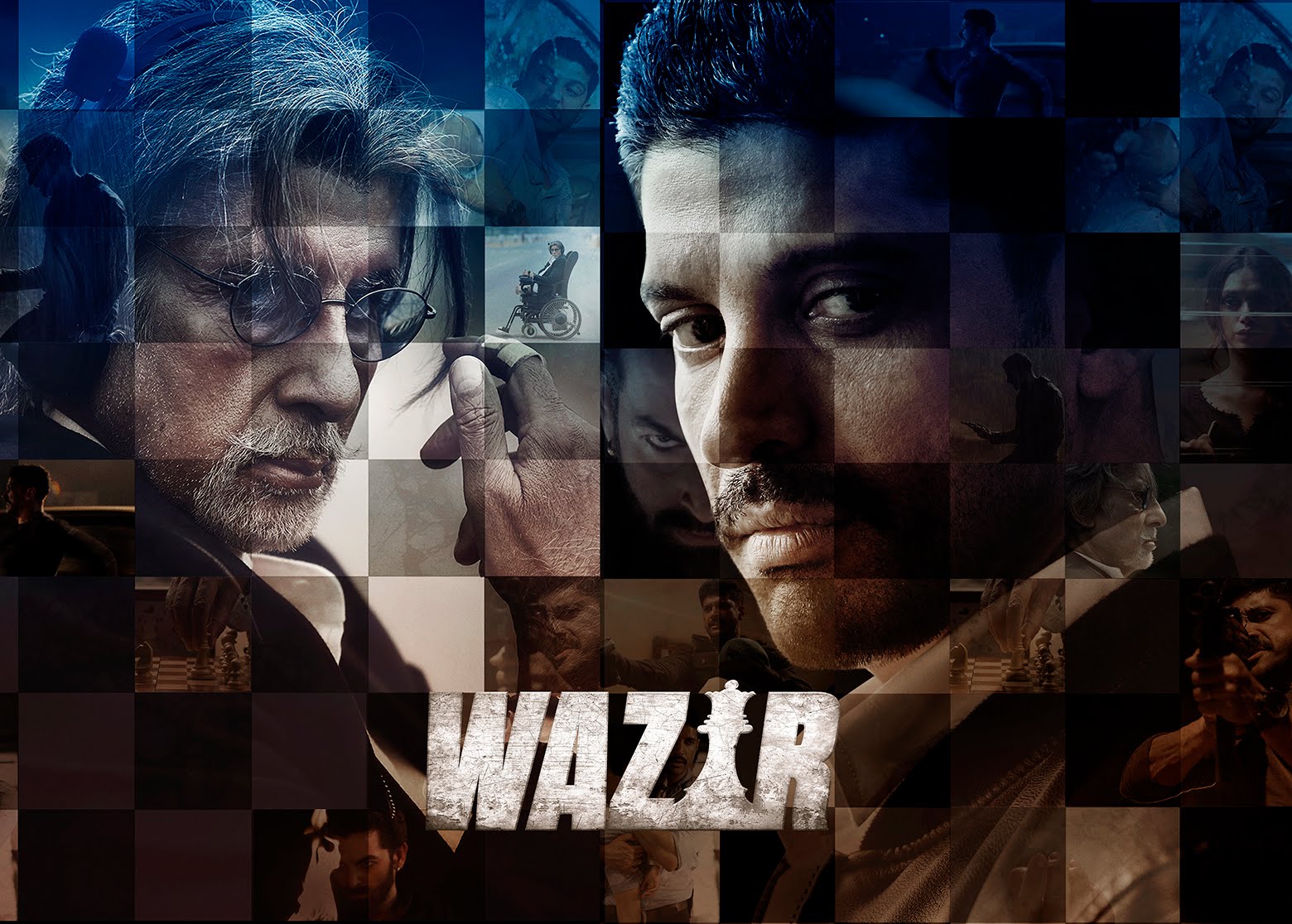
Wazir is an action thriller based on a story by Vidhu Vinod Chopra. Set in Delhi but tied up with Kashmir, the film follows an ATS officer Danish Ali (Farhan Akhtar) as he tries to uncover the links between a terrorist organisation and the politician who is secretly funding them. Things very soon spiral out of control and professional pursuits become personal vendettas when his daughter dies in the crossfire. Estranged from his wife Ruhana (Aditi Rao Hydari) and debilitated by grief, he befriends a wheelchair bound chess master Pandit Omkarnath Dhar (Amitabh Bachchan).

Chess is central to the narrative and the metaphors of chess colour every aspect of it. The scenes where the, at first detached Danish is defeated by five year olds are fun to watch. They are a pressure-valve from the rather dark narrative. While these chess games make Danish and Omkar close friends, they also create an empathetic space wherein both seek understanding and closure as fathers because they are beset by a sense of impotence due to fate’s manipulations.

The film is a meta-narrative; a story within a story or maybe many stories because every character seems to be presenting a story and strangely enough each story is like a move in a chess game – calculated. The characters then become like pieces on a chess board, some also try to be the players. A little fore knowledge of chess may make certain things apparent like how the Elephant can by castling defend the King or how the Wazir (Bishop) can take on the powers of a Queen. Deciphering this make it something to chew on.

One has to draw parallels with Suniel Shetty’s character in Main Hoon Na who says something to the effect of ‘all wars are personal’ – this is central to the film.

However, an analogy for the film is that of the soufflé that didn’t rise. It is delectable and most would devour their portions but it lacks something. A short story is a tightly packed narrative and since a film cannot be so compact, it needs to be more expansive. Yet at times the film needlessly explains itself. That makes it a little tedious to a viewer.

The cinematography is beautiful but the editing could have been tighter. John Abraham’s character is wasted in the film but Sartaj (Anjum Sharma) forms a good foil to Danish’s impetuosity. Danish is a problematic character because he charges blindly into a situation and his reaction at the penultimate moment of the film is incongruous in terms of human behaviour. This could be seen as a flaw in the narrative structure.

The characters are on the whole well-crafted with Omkarnath Dhar standing out as the showman and Yazaad Qureshi (Manav Kaul) as a pivotal character. A scene that is testament to Kaul’s abilities is when he calmly sits down and rolls up his sleeves, all the while keeping a civilised appearance and calmly questioning his daughter. It leaves a knot in the stomach that threatens to overwhelm the viewer’s composure.

The List: Films on Food #SherylPuthur

We should look for someone to eat and drink with before looking for something to eat and drink – Epicurus

Food is denial. Food is pleasure. Food is honest. Food is sinful. Food is expression. There are many ways we label what we eat and would like to eat. So closely connected with bodily functions, it has been rejected, upbraided and worshipped. So presenting, a collection of films that excite the sensory organs – Films on Food.

Food is the near-perfect beginning to a New Year. The films are placed in the order of release, with the oldest first. It is the reader’s decision as to what makes their list and what doesn’t. The table has been set, please enjoy your meal!

Babette’s Feast (1987)

babette's feast

Director: Gabriel Axel Screenplay: Gabriel Axel Story: Karen Blixen

Gabriel Axel’s adaptation of Karen Blixen’s short story Babette’s Feast has fable-like qualities. Set in a desolate landscape, the Jutland Coast, it narrates the story of two elderly sisters Martine (Brigitte Federspiel) and Philippa (Bodil Kerr), the daughters of the deceased puritan pastor of the village. The story delves into their past to explain how they came to employ a French housekeeper Babette (Stephane Audran). The story comes a full circle with Babette’s celebratory feast in honour of the birth anniversary of the pastor. The feast juxtaposes a fine food connoisseur against the simple folk of the pastor’s austere sect, who believe extravagant food is sinful. There is displayed in the film, paternal selfishness and a loss of the original idea of what the religion was to stand for but the beauty of the film is that it does not condemn but accepts. The meat preparations may seem unpalatable to vegetarians but there is so much more to it than just that. Pope Francis has claimed this to be his favourite film.

Chocolat (2000)

chocolat

Director: Lasse Hallstrom Screenplay: Robert Nelson Jacobs Story: Joanne Harris

Set in a quiet French town that believes in tranquillity especially during the season of lent, the film follows Vianne (Juliette Binoche) and Anouk (Victoire Thivisol), who like the wily north wind blow surprising changes into the lives of the townspeople. The film is rather obviously about chocolate but also living life as opposed to seeing the time on earth as only a preparation for the heavenly abode. Life is not for flagellation alone but pleasure as well.

The film sells the idea that chocolate could be the answer to every ailment and the viewer willingly buys it because it is so exquisitely presented.

For more, read my full review of Chocolat.

Under the Tuscan Sun (2003)
Under the tuscan sun

Director: Audrey Wells Screenplay: Audrey Wells Story: Frances Mayes

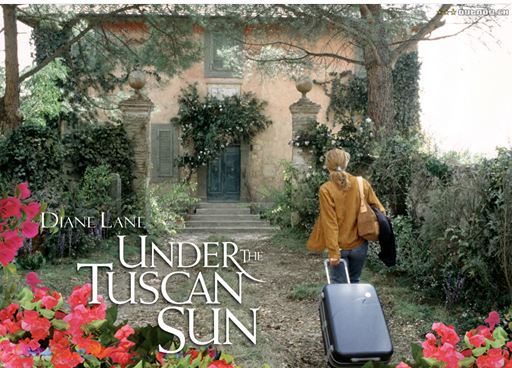
Most would catalogue this movie into films on Travel. While it is true that it is about travelling to Tuscany, it is also a film about self-discovery.

Frances Mayes (Diane Lane), a writer and book critic, goes through a painful divorce, battling insecurity and lack of self-worth. A gift by her friends sees her on a trip to Tuscany. There, she makes the impulsive decision of buying an Old Italian villa because she feels it’s a sign. In the process of restoring the villa, she begins to heal and more importantly, build valuable relationships, with the workers, her neighbours, potential love interests and Katherine (Lindsay Duncan), the enigmatic English female actor who doles out advice by the Great Fellini and vociferously defends vanilla ice cream’s power ‘to change fate’. Traditional Italian families still believe in the sit down dinner because as Placido (Roberto Nobile) points out “it is unhealthy to eat alone.” Sharing a meal and having someone to cook for is the warmest idea of community.

Ratatouille (2007)
sotm_ratatouille_movie_poster_by_froggiechan-d3f89tr

Director: Brad Bird Screenplay: Brad Bird Story: Jan Pinkava; Jim Capobianco; Brad Bird

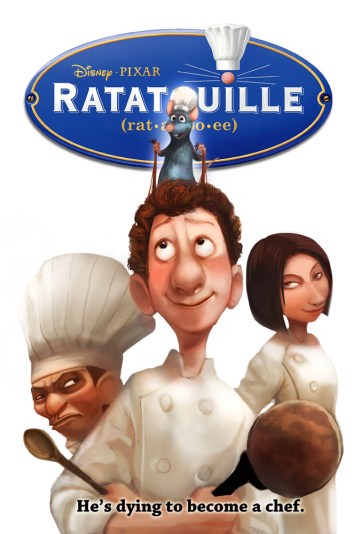
Remy (Patton Oswalt) is a rat who has a wonderful sense of smell and the creative mind for cooking. Of course, the chances of a rat being allowed to cook in a restaurant are next to impossible, which is why a chance relationship with Alfredo Linguini (Lou Romano) the garbage boy, results in a partnership that lets each have what they want. Throw in a couple of short-sighted avaricious villains, a frightening sallow-faced food critic Anton Ego, voiced by Peter O’Toole and – Bon appétit!

The signature line of the film, in Chef Gusteau’s words – Anyone can cook!

No Reservations (2007)

Aaron_Eckhart_in_No_Reservations_Wallpaper_6_1024

Director: Scott Hicks Screenplay: Carol Fuchs; Sandra Nettlebeck

No Reservations is about two chefs who end up working in the same kitchen to interesting results. Kate Armstrong (Catherine Zeta-Jones) is a fastidious head chef of a popular restaurant. The untimely death of her sister makes her the guardian of her nine-year old niece Zoe (Abigail Breslin). From being someone who doesn’t allow people and relationships to interfere with her work she now has to deal very closely with grief and more importantly, her niece’s grief.

Added to that disturbing state of affairs, is the entry of the new sous-chef her boss Paula (Patricia Clarkson) hires. Nicholas Palmer (Aaron Eckhart) is a carefree chef who is popular in his own right but wishes to work under Kate and hence joins the restaurant. Kate is suspicious of his motives but slowly begins to warm to him. The rest of the film follows the characters as they journey towards a sense of completeness. While not particularly moving, the obsessive love for cooking displayed by Kate is awe-inspiring. Especially her early morning visits to get the best ingredients for her dishes, making it a point to choose them herself.

Julie and Julia (2009)
julieandjulia

Director: Nora Ephron Screenplay: Nora Ephron Story: Julie Powell; Julia Child; Alex Prud’homme

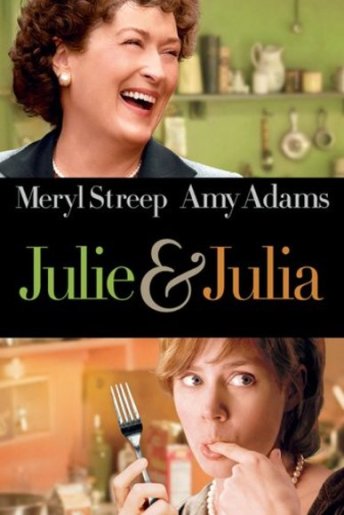
Julie and Julia is based on two true stories – that of Julia Child and the other of Julie Powell. They have both moved to a different place because of their husbands work. While Julia (Meryl Streep) happens to love France, Julie (Amy Adams) hates her new home. Both women find themselves in a rut professionally, and use food to find themselves – one as a cook and the other as a writer. What is really beautiful about the film is that Julia Child’s journey which took place post World war helps Julie Powell find herself as she decides to make all of Child’s recipes and blog about it. The relationships of the characters with each other even through space and time and most certainly with food, defines the film.

Stanley ka Dabba (2011)
Stanley-Ka-Dabba-Movie-48982_65

Director: Amole Gupte Story: Amole Gupte

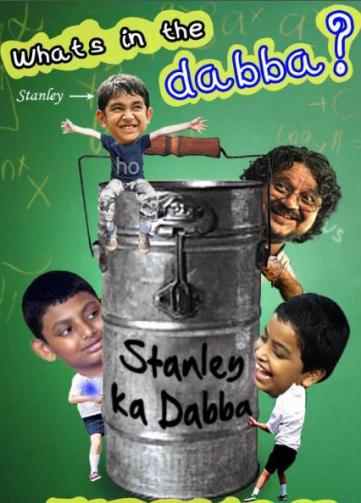
Stanley ka Dabba is a children’s film with heart. It says so much but does so without being preachy. A sense of nostalgia coupled with a vague sense of unease accompanies the viewer as they follow Stanley’s story. The film opens with Stanley (Partho Gupte) coming rather early to school with marks that look suspiciously like bruises. However, Stanley is a storyteller who can spin a yarn about just anything and that makes him well-loved. He doesn’t carry a dabba (tiffin) to school so one begins to suspect the state of affairs at home. One poignant scene shows him filling his stomach with water because he has no food.

There is also a teacher Babubhai Verma (Amole Gupte) nicknamed Kadoos (grumpy) who also does not carry a dabba but eats from others. He steals from the tiffins of his colleagues or else bullies students into sharing their food. His mannerisms are disturbingly that of a child abuser and within the narrative an important metaphor.

Food is central to the film but it is about the simple meal a child would carry to school in a dabba. It states the value of a home cooked meal.

Salt and Pepper (2011)

salt-n-pepper-look

Director: Aashiq Abu Screenplay: Syam Pushkaran; Dileesh Nair

The title of the film is a pun on food and age. It follows Kalidasan (Lal), a middle-aged archaeologist who is a food connoisseur. His closest relationship besides his work and food is with his cook Babu (Baburaj). Even his nephew Manu Raghav (Asif Ali) loses precedence in front of these. A missed call by Maya (Shweta Menon), a dubbing artiste, leads to a misunderstanding between Kalidasan and her. Eventually, their shared love for food becomes the foundation stone for a telephone friendship. The conversations follow the histories of various dishes especially Joan’s Rainbow cake. Their own romance and that of the secondary couple display classic elements of Shakespearean drama. The fact that love has no age makes this film comfort food.

Ustad Hotel (2012)

ustad

Director: Anwar Rasheed Screenplay and Dialogues: Anjali Menon

Ustad Hotel is Faizi’s story. The beauty is, Faizi’s (Dulquer Salman) story starts long before he was born. His one defining memory is shown to be, his grandfather Kareem ikka (Thilakan) feeding baby Faizi sweet milk. Food in all its forms makes up this movie. Be it the conversations on love and philosophy over a cup of sulemani chai between Kareem ikka and Faizi, or that being a good cook is about satisfying the heart.  Conversely, there is a stigma attached to becoming a chef in the rich orthodox Muslim community. Chef = the guy who makes biryani at a feast. Hence, it’s not an honourable profession. It makes Faizi a poor match for Shahana (Nitya Menen). The film is then about changing stereotypes and fixed notions of what your destiny is.

The film with its evocative camera work and vivid dialogues brings forward a mouth-watering array of Calicut cuisine.

The Lunchbox (2013)
The_Lunchbox-410999655-large

Director: Ritesh Batra Screenplay: Ritesh Batra

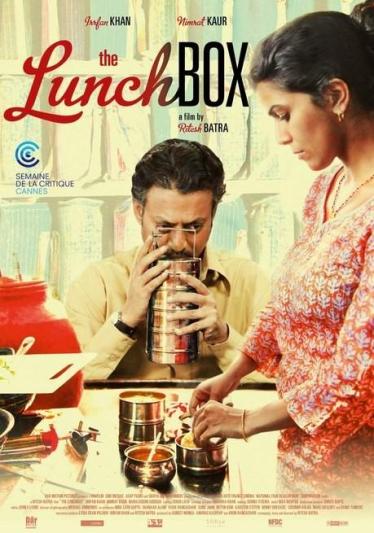
Originally planned as a documentary on the Dabbawalas of Mumbai, it developed into a love story between a cantankerous office worker and a house wife. Saajan Fernandes (Irrfan Khan) is due for retirement and has shut himself post the death of his wife. Ila (Nimrat Kaur) is trying to regain her husband’s interest in her by making delicious lunches for him. However, the lunchbox, in a one in a million chance gets wrongly delivered to Saajan. On realising her mistake, Ila writes a note explaining herself and that starts off an exchange of experiences through notes, accompanied with delicious lunch.

The film does a lot of things differently. It shows a connection being drawn through the old fashioned means of writing a letter. It is a portrayal of loneliness and the need for validation from another human being.

Chef (2014)

Chef-2014-full-movie-hd-online

Director: Jon Favreau Screenplay: Jon Favreau

A head chef Carl Caspar (Jon Favreau) in a fine dining restaurant drags his reputation through the dirt after engaging in an online slingfest with a popular food critic who pans his cooking. Post his rather public meltdown, he walks away from the restaurant and finally agrees to his ex-wife Inez’s (Sofia Vergara) decision to start a food truck. The road trip that he sets on is as much about finding his creative centre as it is about mending his dented relationship with his son Percy (Emjay Anthony).

The film abounds in clichés but certain things set it apart, for instance his relationship with his ex-wife who is still very supportive. The surprise element like the legendary chemical X is Robert Downey Jr. who plays Marvin, Inez’s ex-husband. He literally lights up the screen. And yes, the food. If it was humanly possible to put your hand through the screen and grab a cubano you would do it. It is your junk food fantasy film.
 

Bajirao Mastani (2015) #SherylPuthur


Bajirao-Mastani-wallpaper-3

Directed By: Sanjay Leela Bhansali

Written By: Prakash Kapadia

Cast:

Ranveer Singh – Bajirao I

Priyanka Chopra – Kashibai

Deepika Padukone – Mastani

Tanvi Azmi – Radhabai

Vaibbhav Tatwawdi – Chimaji Apa

Milind Soman – Pant

Aditya Pancholi – Pratinidhi

Ayush Tandon – Nanasaheb/ Balaji Bajirao

Mahesh Manjrekar – Chhattrapati Shahu

Irrfan Khan – Narrator

Language: Hindi; Marathi                       Genre: Action; Romance; Drama

Bhansali’s Bajirao Mastani is a true love story of epic dimensions brought out from the shadows to which history has confined it to appease powerful yet blinkered mindsets.

Bajirao (Ranveer Singh) is a young warrior of an illustrious lineage who is elected to the office of Peshwa in the Maratha Empire despite his youth, because of his breadth of vision and intelligence. Willing to take risks and making impulsive decisions, he embarks on several successful military campaigns. While not accompanied by his wife Kashibai (Priyanka Chopra), her devotion to him is his strength.

It is the impulsive campaign to Bundelkhand that brings Bajirao face to face with Mastani (Deepika Padukone), a princess of Bundelkhand. He falls in love with her but realises that a union between them is unlikely so he returns, pushing away thoughts of her. Mastani, however, takes a particular act of his as a sign and follows him to Pune. It is here that all the subterfuge against this unacceptable union begins. It is helmed by Bajirao’s mother Radhabai (Tanvi Azmi) and her son Chimaji Apa (Vaibbhav Tatwawdi).

It is almost frightening to witness how fanatical people can be about ritual purity, religion and the ilk. It is ironical too because the people oppose the Mughal Empire and Muslims but use Urdu-influenced Hindi in official and personal contexts. A significant line in this context is by Bajirao when he said (it’s not a verbatim quote) that yes he fights against the Mughal Empire because he is against them and what they do, not their religion. This is a telling statement in the current socio-political situation as people get blindsided by belief systems that have almost hypnotic qualities. The film is thus subtly critical of the times.

However, what was a letdown is that film focuses on the interior intrigues of Shaniwar Wada (Peshwa’s house) as opposed to the Maratha Empire. The character of the Pratinidhi (Aditya Pancholi) thus becomes a little underused because there were many political intrigues that involved the Peshwa and him in opposing factions.

Strangely enough, for a movie titled Bajirao Mastani, Mastani seems to be in the shadows and Kashibai is much more prominent. The filmmaker is sympathetic to Kashibai’s plight because she is the simple-hearted woman who finds her faith in Bajirao shattered by the entry of another woman. She believed that he could never do anything wrong and was a moral, upright man. One of the opening sequences, show her in conversation with her friend whose husband was executed by Bajirao for spying against him. It is Kashibai’s vehement refusal to accept any slight against her husband that makes the scene poignant.

It is then fitting, that a woman like Mastani, whose story has frequently been the focus of erasure or sidelining by forces then and now, should still be cloaked in mystery. Bajirao-Mastani’s love story is affecting because even if the orthodox society of his times chose to see her as his mistress, he saw her as his lawfully wedded wife and did everything to give her and their son, equal rights. Their love story in the film hasn’t been given much time to develop, say unlike the romance in Hum Dil De Chuke Sanam. This could be a bit of disappointment but then again, it is a film for the 21st century audience.

Interestingly, the film posters give the first clues about the portrayals in the film – the left side of any image is seen as less eye-catching because generally humans see the right side as more dominant. So it is appropriate then that Kashibai is to the left of the viewer, however, her image is more forward-positioned. Mastani is appropriately to the right, yet her image is withdrawn from the viewer’s gaze. Bajirao’s is a centred image, very squarely placed – like someone whose position in history cannot be shaken.

Bajirao’s relationship with Kashibai is eloquently played out by the actors. Their marriage is based on friendly camaraderie and shared confidences. Nevertheless, their intimacy plays out in a rather traditional manner with Kashibai being the recipient of her husband’s desire. On the other hand, Mastani, probably because of her experiences as a warrior, is more straightforward about her feelings and passionate in her expression.

The film performance-wise and casting-wise is impeccable. The casting of Milind Soman as Pant was a refreshing change and his interactions with Bajirao have a drawing power to them. Even the interactions between Radhabai and Kashibai are noteworthy and reveal the extent of their filial devotion. All the characters hold their own in the narrative.

And it is Ranveer Singh’s finest performance to date. He is Peshwa Bajirao in every frame, though the song Malhari is a little discomfiting.  It is a great listen but if he was Bajirao in every frame, in this song he was more of a controlled Ranveer Singh. Pinga however, is actually brilliant, so pay close attention to the lyrics.

A film made for modern audiences; it may seem slightly fast-paced in terms of narrative but still possesses a well-meshed screenplay and flawless camera-work with all the grandeur of a Bhansali film.

Tamasha (2015) #SherylPuthur

tamasha_144282729100

Directed By: Imtiaz Ali

Written By: Imtiaz Ali

Cast:

Ranbir Kapoor – Ved Vardhan Sahni

Deepika Padukone – Tara Maheshwari

Javed Sheikh – Ved’s father

Vivek Mushran – Ved’s Boss

Language: Hindi                                                            Genre: Romance; Drama

Tamasha (Spectacle) refers to the local folk performances of popular oral narratives either from the epics, religious texts or popular ballads. This is a tradition by no means unique to India as every country possesses a tradition of local theatrical performances. These performances work on the fore knowledge of the audience and frequently include artistic deviations.

Imtiaz Ali’s Tamasha has these local performances strewn through the film (both Indian and foreign, such as in Corsica there is a local procession). Performance and spectacle is central to the film, interestingly, even in human relationships. What is appropriate behaviour and how should you project yourself in a socially accepted manner.

The film follows Ved (Ranbir Kapoor) who grows up with an understanding that there are two lives to live – one the socially accepted life and the secret pulsating life of dreams. As a child Ved, visits the local storyteller to be transported into a world of fantasy.

So when he meets Tara (Deepika Padukone) for the first time at Corsica, he tries to live his ‘once upon a time’ moment – an escapist fantasy, by projecting his imagined idea of himself. So they decide not to tell each other the truth of their identity, he introduces himself as Don and she is Mona Darling. They spend a few days in Corsica and decide never to meet again. Tara however, cannot get over him and eventually searches him out. But now he turns out to be the anti-thesis of everything Don was. She rejects him and everything spirals out of control.

Like Imtiaz Ali’s Rockstar, this too is a ‘finding yourself’ narrative and as in both the focus is on the male character. The female character is exuberant and holds a commanding presence on the screen but ultimately is just the muse or the catalyst that sends them on a journey which has destructive consequences but is eventually creative in expression.

The storytelling is riveting and replete with popular culture references. Such as Catch-22 – this is significant, because a catch-22 situation is what underlies Ved’s dilemma.

The performances are compelling much like the narrative with both actors giving mature performances. A special mention – Ranbir Kapoor presents with frightening intensity the cracking up of an invisible character (in fact, a very Fightclub moment does exist in the film). If he in the future chose the role of a psychopath/sociopath – it would be chilling. However, in comparison to earlier films, there is a drop in the exuberant energy that had become almost synonymous with his performance. Deepika on the other hand, has scaled heights as an actor. Coming so close on the heels of Piku, her performance has a riveting fluidity to it.

Certain sequences in the film were too contrived. The segment in Corsica for instance, was at its worst – unfunny, and the scene between Ved and his father (Javed Sheikh) – unbelievable. The song Agar Tum Saath Ho was moving, with Deepika’s performance leaving you with a tightening sensation in your chest. Strangely though, others in that space do not react to their rather vocal argument which wasn’t very logical but I would like to assume Ali crafted the scene to emphasise the alienation in society.

While absorbing, the storytelling does lose out in the editing, making the screenplay haphazard. Something I found even in Rockstar which makes the story a little scattered.

Do stay to watch the credits to the end because Imtiaz Ali gives a beautiful tribute to the various performers by having the cast list begin with the names of the dancers, musicians etc who are so central to the narrative. To me, that was outstanding.


Centurion (2010) #SherylPuthur

Centurion

Directed By: Neil Marshall

Written By: Neil Marshall

Cast:

Michael Fassbender – Quintas Dias

Olga Kurylenko – Etain

Dominic West – Titus Flavius Virilus

Liam Cunningham – Ubriculius

David Morrissey – Bothos

J J Feild – Thax

Ulrich Thomsen – Gorlacon

Noel Clarke – Macros

Riz Ahmed – Tarak

Dimitri Leonidas – Leonidas

Imogen Poots – Arianne

Paul Freeman – Gnaeus Julius Agricola

Language: English and Gaelic   Genre: Historical, Action-war; Thriller

Centurion is a 2010 British action thriller war movie set in Scotland during the time of the Roman occupation of the British Isles. Rome had already conquered England and Wales and was trying hard to bring Scotland under them. The film focuses on the Ninth Legion whose fate is still unknown or unclear, giving an alternative reading to the story.

Stories have circulated about the fate of the missing Ninth Legion. Some scholars believe it happened on the main continent of Europe while fighting off a warring tribe, others that it was the Jews who routed them. But most scholars feel it may have happened on the British Isles while fighting off the Picts. The Picts were the ancient inhabitants of Scotland and were called Picti (painted people) by the Romans because they painted their faces, especially before war.

The film is from the perspective of a Roman centurion Quintas Dias (Michael Fassbender) whose garrison was ambushed and destroyed by the Pictish warriors, leaving him the sole survivor. Dias is tortured for information by Gorlacon (Ulrich Thomsen) a Pictish leader because he spoke the Pictish language.  He refuses to help them and escapes captivity seeking refuge with the Ninth Legion under General Titus Flavius Virilus (Dominic West).

Governor Agricola (Paul Freeman) wants the Ninth Legion to take some decisive action against the Picts and asks Virilus to make use of the skills of Etain (Olga Kurylenko), a Celtic Brigantian who can lead them into Pictish territory. They, however, are ambushed by the Picts. The end result – Virilus is taken captive.

The seven survivors of the ambush – Dias, Ubriculius (Liam Cunningham), Bothos (David Morrissey), Thax (J J Feild), Macros (Noel Clarke), Tarak (Riz Ahmed) and Leonidas (Dimitri Leonidas) decide to sneak into the Pictish village and rescue Virilus. What adds a trying measure of responsibility and guilt on Dias is the promise that Virilus demands of him. It is this journey, of fulfilling the promise and reaching to safety, fraught with danger and sure death that dominates the rest of film.

The film shows how the ruling faction – the Romans, is reduced to being the chased and the hunted. They are shown slowly descending into unethical behaviour just to survive, breaking whatever codes of honour they were expected to follow. Yet Dias does emerge as a throwback figure to the old order of chivalry, the ‘I give you my word’ kind of honour.

Etain on the other hand, comes across as a formidable opponent – a tracker and a hunter, she inspires fear yet plays an ambiguous role in the narrative making her a character you also sympathise with.

The Picts too have their flaws. It is in the character of Arianne (Imogen Poots) that it becomes most apparent. She is branded as a witch by Gorlacon, scarred and then made an outcast.

The film does not present one side as villains and another as the heroes but tries to present both sides as violent and sometimes, justified.

The engaging aspect of the movie is that the Picts are not projected as this barbaric tribe but given a voice to express their struggle against the foreign invaders – which is an alternative view to Roman Britain.  The general opinion projected about the Roman Empire in Britain has always been about pride in its still existing symbols like the holiday spot Bath for instance. This then highlights the resentment that probably still exists in Britain about the subjugation by the Romans.

There is much violence and gore in the film – torture scenes, decapitated heads but the spurts of blood seem more video game-like and hence not very realistic. Nevertheless, the violence is a little startling.

Centurion may have taken liberties with actual history, presenting characters that may have not actually been there during the time period of the story (Agricola). Also it may have not given much of a curve to the characters but it does seem realistic as opposed to The Last Legion which fused the Arthurian legend into the fate of the Ninth Legion making it supernatural and a tad bit unbelievable.


Shirley Valentine (1989) #SherylPuthur

f4ac6f53335a57a55e22ffc8482e9d03

Directed By: Lewis Gilbert

Written By: Willy Russell

Cast:

Pauline Collins – Shirley Valentine-Bradshaw

Tom Conti – Costas Dimitriades

Julia McKenzie – Gillian

Alison Steadman – Jane

Joanna Lumley – Marjorie Majors

Sylvia Syms – Headmistress

Bernard Hill – Joe Bradshaw

Tracie Bennett – Millandra Bradshaw

Gareth Jefferson – Brian Bradshaw

Gillian Kearney – young Shirley

Catherine Duncan – young Marjorie

Language: English                                   Genre: Romantic-Comedy; Drama


The interesting thing about Shirley Valentine is that it overturns the stock terms used to describe the genre and theme of the film – romantic comedy about a bored housewife who goes on a holiday to Greece and rediscovers herself; love and life. This description would be too simplistic.

The romance in this film isn’t about Shirley (Pauline Collins) being enamoured by the Greek bar owner Costas (Tom Conti) who helps her rediscover pleasure but it goes back to a far older and poetic meaning of romance or otherwise known as romanticism.

The Illustrated Dictionary of Essential Knowledge defines romanticism by saying it “stressed the value of personal emotion and imagination and freedom from the strict rules of form…” (72). It also laid emphasis on man’s, “innate powers of creativity, his spontaneity and his relationship with the natural world” (145).

When looked at from this lens, the film isn’t about a bored housewife (two words that carry its fair share of connotations) but about a woman who has given up on herself. Shirley is someone who has judged herself to be irrelevant or just a fixture in the house because she is in her eyes, a failure.

Her days are spent talking to the kitchen wall or ‘The Wall’ because there is no one else she can confide in. Making her husband Joe’s (Bernard Hill) routine dishes for tea is the other exciting diversion of her life.

The older Shirley also carries baggage from her high school days of not measuring up to the exacting standards of the headmistress (Sylvia Syms) who believed that the young Shirley (Gillian Kearney) was incapable of amounting to anything.  She felt unfairly compared to the school’s ‘perfect girl’ Marjorie Majors (Catherine Duncan).

However, a chance meeting with an older Marjorie Majors (Joanna Lumley) makes her realise that she does not the live the glamorous life Shirley assumed she would. And when Marjorie confesses that she envied her at school, it comes as a surprise to Shirley that a nonentity like her could be envied.  One realises that people love making assumptions about themselves, situations and others so the first step to rediscovery comes from breaking them.

The film shows that while visiting an exotic location for a holiday may be romantic, living there day-in and day-out takes some of the romance away. But the point of Shirley staying at Greece was not about an exotic experience alone but as a new take on life.  So doing even mundane activities like talking to ‘the wall’ or making chip and eggs for ‘unwilling to experiment’ British tourists are still charming.

A scene that was both hilarious and warm was when Joe begins talking to the wall. You notice a man who was once willing to experiment but responsibilities made him choose stability instead. Now when external circumstances force him to reconsider, it is with a sudden awareness that he is actually lonely and has been so for so long. So he converses with the wall to retain a connection with Shirley.

The reactions of her children add to the drama of the narrative but what takes it forward is her self-righteous neighbour Gillian’s (Julia McKenzie) open-hearted support of Shirley’s decision to take her life in her hands. It is moving to see the honest appreciation and the vicarious longing behind her action of gifting a silk robe.

By turns droll and stirring, the film is an honest and ordinary woman’s decision to fall in love with life. Not as a mother, or a wife or a lover but as Shirley Valentine. It falls within that special bracket of films about women who strike out on their own, either by choice or circumstance such as English Vinglish, Queen, Under the Tuscan Sun – to accept the changes in themselves; without guilt.

Special mention: the script – unemotional, funny yet warm it conveys a woman’s journey without the usual clichés of travel romances.

Me Without You (2001) #SherylPuthur

me-without-you michelle anna

Directed By: Sandra Goldbacher

Written By: Sandra Goldbacher; Laurence Coriat

Cast:

Anna Friel – Marina

Michelle Williams – Holly

Oliver Milburn – Nat

Kyle MacLachlan – Daniel

Trudie Styler – Linda

Allan Corduner – Max

Marianne Denicourt – Isabel

Deborah Findlay – Judith

Nicky Henson – Ray

Adrian Lukis – Leo Muller

Language: English                                                          Genre: Romance-Drama

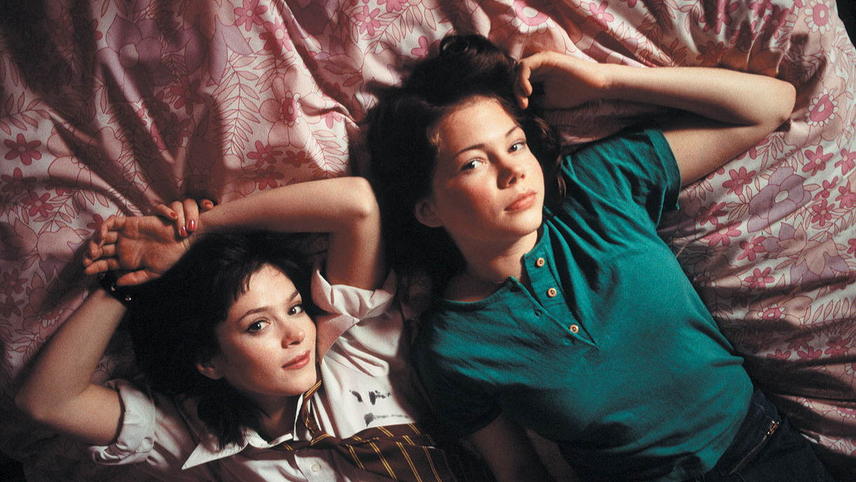
Me Without You is a poignant film about the toxicity of long friendships. It follows the friendship of Holly (Michelle Williams) and Marina (Anna Friel) from 1973 when they are 12 years old to 1978; 1982; 1989; 2001 – each time period marking an important curve to their relationship.

Marina and Holly each have something the other desires. They are not happy with their lives and want the other’s life. This discontent grows as they grow. Marina feels unloved because her parents are separated and seem particularly self-involved. Holly’s family is Jewish. Her mother is both overprotective and seems to highlight Holly’s insecurity about her appearance. Marina wants stability and Holly wants to be as beautiful and carefree as Marina.

When they are kids, their ‘admiration’ for each other’s life does not get out of hand. But with the passing of years they realise the truth of the circumstances around them and find they cannot hold on to childish fantasies anymore. It is then that their jealousy becomes obvious.

For Marina, her looks and outgoing personality becomes the superior ‘skill’ she can lord over Holly. But when ‘mousy’ Holly manages to attract the attention of Nat (Oliver Milburn), Marina’s brother, at a drugs and music party his girlfriend organises, Marina is unable to deal with it. She instinctively realises that they will probably be great for each other even though at that point Nat wouldn’t date her since he was with someone else but just maybe later. This is the point when the poison seeps in and there is no more childlike excitement at being ‘Harina’ – Holly+Marina.

However, there is an awareness that they need the other, so no one overtly rocks the boat but covertly they try to undermine the other. For instance, when they are studying at university Holly finds herself attracted to her professor Daniel (Kyle MacLachlan). Marina finds him silly but later makes it a point to seduce him and it is as though she wants to hit out at Holly. When this incident nearly escalates into a full-fledged fight, Marina instead of letting it damage their friendship deflects it by damaging the fledgling relationship Holly and Nat develop after he returns from his French sojourn.

Holly and Marina are frequently referred to as being each others’ mothers, Siamese twins, a married couple – hinting at their cloying proximity. A proximity, that is rather desperately maintained but has no real engagement.

A pivotal scene in the film, which marks Holly’s growing frustration at Marina’s controlling behaviour, and yet fear against openly voicing it out is when she mentions being puzzled at Marina’s decision to become Jewish after marriage since her fiancée is Jewish. Marina’s retort – “Why shouldn’t I be Jewish? Huh? It gives me a sense of identity” and Holly’s response in an undertone, “Really? Whose identity?” underscores what has happened to them.

In an unequal relationship, one will play the role of the manipulator and the other the victim. The victim will eventually either lash out or accept the victimisation and grow to use it as a cloak to garner sympathy resulting in possibly an even more warped personality. What would be healthier would be to claim individuality and strike out alone. However, it is hard when that said relationship is with your closest friend.

Me Without You isn’t saying that female friendships are warped or that the idea of childhood friends sticking together in a healthy manner is a fairytale but that true growth can only happen with some distance from those who know you too well. The truth is, they know only one aspect of you and would find it strange if you became something else. But moving away, isn’t to destroy an older relationship but to discover yourself in newer relationships.

Maybe why female friendships are more prone to manipulation has probably to do with female socialisation. Boys are socialised to ‘let out’ their frustrations especially with each other so they get into physical brawls when there is a tense moment. But girls are told to ‘rein in’ their emotions and hence let it fester.

I found this an incredibly moving and beautifully shot film because of the rounded characterisation, the chemistry between the lead characters and how the narrative keeps you hooked without being soppy. Also, the ending I find is interestingly open-ended.

Chocolat (2000) #SherylPuthur

chocolat

Directed By: Lasse Hallstrom

Written By: Joanne Harris; Robert Nelson Jacobs

Cast:

Juliette Binoche – Vianne Rocher

Victorie Thivisol – Anouk Rocher

Alfred Molina – Comte de Reynaud

Judi Dench – Armande Voizin

Hugh O’Conor – Pere Henri

Lena Olin – Josephine Muscat

Peter Stormare – Serge Muscat

Johnny Depp – Roux “river-rat”

Language: English                                                          Genre: Romance-Drama

Chocolat opens with a beguiling fog that slowly reveals a quaint French village atop a hill, surrounded by walls, looking much like fort. The fog seems reminiscent of the steam that surrounds a vessel on the stove, which you brush aside to continue with your creation. What you discover is that food, in every manifestation (even metaphorical), is present in the film. Food and its close associate denial.

Set fifteen years after the Second World War when the world was recovering, yet hadn’t quite found its joie de vivre, the story follows a young chocolatier and her daughter who arrive in this village that is beginning its Lenten period of fast and abstinence. It is a village that believes in tranquillity and Vianne (Juliette Binoche) and Anouk (Victorie Thivisol) destroy it by being different.

The Mayor of the village Comte Reynaud (Alfred Molina) both practises and enforces moral austerity on the people. Vianne’s open flouting of the Lenten rules by opening a chocolaterie, not attending mass and flaunting her unwed mother status, leads him to a covert operation of ostracising her from the community.

He exercises ideological control over the villagers by editing the Lenten sermons of the village priest Pere Henri (Hugh O’Conor). It would be folly to see him as a cardboard villain because the irony is that he believes that he is justified and doing it for the good of the people. He is also quite the gentleman and is actually shocked at the seamier side to people’s lives such as when he finds out that Josephine (Lena Olin) is actually being beaten by her husband Serge (Peter Stormare) and hence left him.

The film thus critiques the practise of being morally right and quick harsh judgement. It also presents how society ensures that people follow the norms laid out by inflicting mental harassment. In this it deviates harshly from true Christian principles of accepting everyone, of not creating hierarchies of morality and of community welfare. It thus makes religion un-enjoyable.

Religion is about joy but people are quick to assume that flagellation of the self will make one superior. One can notice that those who do this – remaining austere by force have no joy and are actually grappling with dark emotions. It seems dark all the more because they are unable to forgive themselves for possessing it.

The confessional then becomes an important motif in the film; some being forced to enter it on the assumption that by just going through the motions of it, it will result in miraculous effects. But most villagers congregate there to confess that they felt pleasure.

Pleasure is given a lot of bad press but there is nothing wrong with feeling pleasure. Eating good food, living life on your terms does not make one a sinful hedonist. (If you want to get a glimpse of hedonism, watch The Libertine – it documents the life of the Second Earl of Rochester). For some reason, people correlate more misery with better chances of going to heaven. This is why Pere Henri’s Easter sermon about the humanity of Jesus Christ as opposed to his divinity makes sense. He lived, ate, drank, had friends, yet people brush that aside and focus only on the forty days of fast and the agony on the cross.

So my take back from the film would be this quote – “We can’t go around measuring our goodness by what we don’t do, by what we deny ourselves, what we resist and who we exclude. I think we’ve got to measure goodness, by what we embrace, what we create and who we include.”

After all, once you understand and respect pleasure, you can be forgiving and open-minded. Pleasure, correctly understood, is liberating.

Thank You for Smoking (2005) #SherylPuthur

Thank-You-For-Smoking-thank-you-for-smoking-547315_1024_768

Directed By: Jason Reitman

Written By: Christopher Buckley

Cast:

Aaron Eckhart – Nick Naylor

Cameron Bright – Joey Naylor

Katie Holmes – Heather Holloway

Maria Bello – Polly Bailey

David Koechner – Bobby Jay Bliss

William H. Macy – Senator Ortolan Finistirre

Robert Duvall – Captain; Founder of The Academy of Tobacco Studies

K. Simmons – “B.R” Nick’s boss

Language: English                                                           Genre: Comedy-Drama

Thank You for Smoking is an adaptation of a novel of the same name. And as its name indicates it is satirical and has a lot to say about smoking.

Nick Naylor (Aaron Eckhart) is a lobbyist and the Vice-President of The Academy of Tobacco Studies. In his official position, he defends tobacco from its negative publicity by arguing cleverly. As he tells his young son Joey Naylor (Cameron Bright), that if you argue correctly, you are never wrong – after all, the irony of the Nobel peace prize is that no one remembers him as the inventor of the dynamite but as the one who instituted this prestigious award.

This takes him through buy-out deals with people whose negative experiences with smoking could harm the stance of his company – tobacco smoking has benefits. It also puts him on the hit list of the anti-smoking campaign Senator Ortolan Finistirre (William H. Macy), who is excessively righteous and believes smoking is a moral problem.

To protect tobacco, Nick Naylor is thrust in the direction of smart advertising by wanting prominent movie stars to smoke after a lovemaking scene to show that smoking is cool. Interestingly, the movie producer’s office is called Entertainment Global Office or EGO. There are quite a few puns strewn in the film like the fact that his son studies in St. Euthanasius School – reminding or ironically presenting the idea of ‘voluntary death’ – a critique of smoking.

What’s really exciting about the film is the various moral questions it throws up. The whole idea of moral judgement – who gets to decide what will be the standard followed and the punishment for deviation. How far would you go to make things right? Would you tamper with existing facts and rewrite history? And, is it right to go overboard and decide what is good for everyone?

It also brings up the paradox of choice – what if circumstances give you limited options and there is a strong moral bias against one option – what will you choose? Also, with advertising trying to make everything desirable, are you really choosing or have you been told you NEED this?

Thank You for Smoking is the other side of the story – it is the story of the hated, the despised and the suspected. Eckhart’s character is someone who is detached from the machinations of society despite his deprecating statements to Heather Holloway (Katie Holmes) about everything being about the mortgage. He believes that his calling is to speak for the truly downtrodden – tobacco. What is refreshing about the film is that it doesn’t give you a run of the mill resolution, last minute changing of spots. It is realistic, quirky and satirical. And yes, certainly a little preachy but it expects you to think.

Inglourious Basterds (2009) #SherylPuthur

Inglourious_Basterds_red_drawing

Directed By: Quentin Tarantino

Written By: Quentin Tarantino

Cast:

Brad Pitt – Lt Aldo Raine

Christoph Waltz – SD Standartenführer Hans Landa

Diane Kruger – Bridget von Hammersmark

Michael Fassbender – Lieutenant Archie Hicox

Daniel Brühl – Private First Class Fredrick Zoller

Eli Roth – Sergeant Donny “The Bear Jew” Donowitz

Til Schweiger – Sergeant Hugo Stiglitz

Julie Dreyfus – Francesca Mondino

August Diehl – Major Dieter Hellstrom

Mélanie Laurent – Shosanna Dreyfus

Sylvester Groth – Joseph Goebbels

Language: English                                                 Genre: War; Thriller; Drama


Tarantino’s Inglourious Basterds takes liberties with spellings and with history. Yet, does it in such a convincing manner that you need to rack your brains to remember things did not pan out exactly that way. It doesn’t help that Tarantino also produced a related black and white film that is at the centre of this film.

The film follows a chapter-wise narrative similar to that in Kill Bill. It depicts the violence that characterised the Nazi regime and the kind of witch hunt that ensued to eliminate the Jews. The menace of the SS is personified in the character of Hans Landa (Chirstoph Waltz). What makes him most frightening, is his polished demeanour and his amoral sociopathic tendencies.

It goes to prove that the truly terrible aspect of any ideology-regime that functions on torture is that the people who might be its most feared supporters (for their immense capacity for brutality) might not actually believe the ideology, but use the regime as a space to let loose their violent impulses.

However, the film also talks of the counter violence that could have and did occur. The group that was central to it were dubbed the Basterds. They comprised of Jews avenging crimes against their people. They were led by Lt. Aldo Raine (Brad Pitt) an American soldier of Apache Indian origin, who wanted his men to get him a ‘100 Nazi scalps’. Having scalps is a sign of bravery and also honour in the Native American culture. Nevertheless, it is a symbol of violence.

There is an important reference to rats in the film. Rats are important because on a ship when they start running away it means the ship is going to sink. Also rats scurry and hide so that they are not found out and killed. You realise when you watch the movie that there is a very thin line separating the rat from the righteous human who wants to kill it. For a time could come, when you could be considered a rat by someone else because of some preferences you have.

Tarantino as always presents violence with comic-horror. It takes away your revulsion for the violence or if not that, numbs you to the brutality on display – following a very Kubrick tradition. However, more than the violence on either side, it is that Tarantino presents the idea of history as a construct. The idea that history is written by the winner is known. Much of the history that we study has that bias. But how about reinterpreting history to serve some purpose?

Governments have done and still do modify history to present a better version of their country or the political parties they represent. This is dangerous because the children who learn this grow up with a skewed sense of the past and hence become easy targets of brainwashing.

Inglourious Basterds throws up a debate on history and how it is a construct, how far ideologies are truly followed and how the metaphor of the rat plays out from the first chapter to the last.